
Voice AI for business is software that answers phone calls, understands what the caller says, and responds out loud in natural speech. For a local business, the strongest use is the call you currently miss: after hours, during a rush, or while your team is with another customer. We build and deploy AI chatbots and voice agents for Northeast Florida businesses so that no lead goes unanswered, and the sections below show how to decide where voice AI belongs in your phone workflow.
TL;DR
- Voice AI uses speech recognition and a language model to hold a spoken conversation, so it can answer, qualify and book without a person on the line.
- The best starting points are after-hours calls, overflow calls and appointment scheduling, with a clear hand-off to your staff for sensitive conversations.
- Measure it like any ad channel: answered calls, booked appointments, hand-off success and customer satisfaction.
- Before launch, confirm your call-recording consent and AI-disclosure obligations. Florida requires all parties to agree to recording.
- Our NV AI Pro Agent is listed at $497 per month, and AI Receptionist setup and deployment at $997 one-off.
Table of Contents
- What voice AI for business is and how a call works
- Where voice AI works best for local businesses
- How to use voice AI for customer service
- What voice AI does for your numbers
- What voice AI costs
- Compliance checklist for U.S. businesses
- How to measure whether it works
- A simple rollout plan
- Voice AI at NetViper Interactive
- Our perspective
- FAQ
- Sources
What voice AI for business is and how a call works
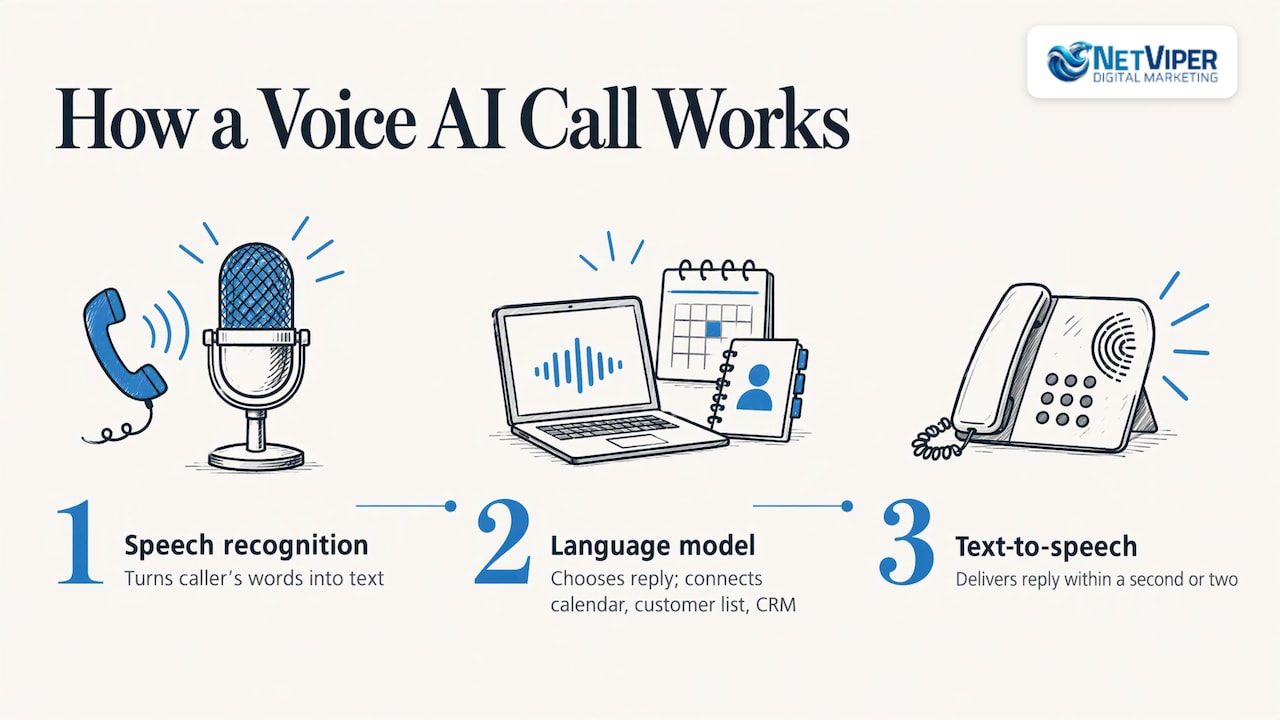
A voice AI agent is a phone-answering system built on three steps. Speech recognition turns the caller’s words into text. A language model decides what the caller wants and what to say back. A text-to-speech voice delivers the reply, usually within a second or two. Behind those steps, the agent connects to your calendar, customer list or CRM (the system where you store customer records) so it can check availability, log the call and trigger follow-up.
This is different from the old phone menu that says “press 1 for sales.” A caller can speak normally, interrupt, change their mind and ask questions in their own words. It is also different from a text chatbot, which lives on your website or in a messaging app. Both are useful. A voice agent covers the channel that matters most to service businesses: the phone, where a caller with a leaking pipe or a broken tooth wants an answer now.
Venture investors who track the category describe the functional opportunities at the application layer as transcription, inbound calling (booking appointments, closing warm leads, managing customer success), outbound calling and screening, training and negotiation, according to Bessemer Venture Partners’ Voice AI roadmap. Money is following the idea: even funding for AI sales agents in emerging markets is making news. For a local owner, inbound calling is the part that pays back first.
Where voice AI works best for local businesses
Start with calls where the caller’s goal is simple and the cost of a missed call is high. Geodesic’s November 2025 enterprise primer names three main entry points for voice AI: after-hours and overflow calls, net-new outbound calls, and back-office calls. Two of the three map directly onto how a small business works.
After-hours and overflow calls
Most local service businesses lose calls at predictable times: evenings, weekends, lunch, and the busiest hour of the morning. A caller who reaches voicemail often calls the next business on the list. A voice agent picks up every time, collects the caller’s name, number and need, and either books the job or flags it for a human first thing in the morning.
Appointment scheduling and routine questions
Booking, rescheduling and confirming are the best-defined tasks in a service business. The agent asks the same few questions every time, checks the calendar and confirms the slot by text. Routine questions about hours, service areas, parking or what to bring are handled the same way, from an approved knowledge base (how that works).
Lead capture from your advertising
If you pay for Google Ads, Facebook ads or Google Maps visibility, every ring is money already spent. A prospect who calls from an ad and reaches no one is a wasted click. Voice AI answers instantly, and automated lead follow-up can respond within minutes by text or email when the caller does not book. Pair it with call tracking and you can see which campaigns produce calls and which calls become jobs.
Common examples by industry
- Home services: after-hours emergency intake, estimate scheduling, service-area checks.
- Medical and dental offices: appointment booking, reminders, insurance-information intake.
- Law, accounting and real estate: new-client screening, consultation booking, showing requests.
- Restaurants and salons: reservations, wait-time questions, rebooking.
More examples are on our AI use cases page.
How to use voice AI for customer service
Treat the agent as the first responder, not the last word. A good customer service setup has four parts.
- A narrow job list. Give the agent three to five tasks to master first, such as booking, hours and pricing ranges, directions, and message-taking.
- An approved source of truth. The agent should answer from your own information: services, service areas, policies and prices you have approved. Answers grounded in your content reduce made-up replies, which Geodesic lists among voice AI’s known weaknesses along with speech-recognition errors in noisy places or with diverse accents, trouble with industry jargon, and interruptions.
- A clear hand-off rule. Decide which situations go to a person: an upset caller, a billing dispute, a high-value quote, a medical or legal question.
- Connected systems. Calls should land in your calendar and CRM automatically so your team never retypes details. Geodesic describes seamless integration with existing systems as a deciding factor in successful deployment.
When to transfer to a person
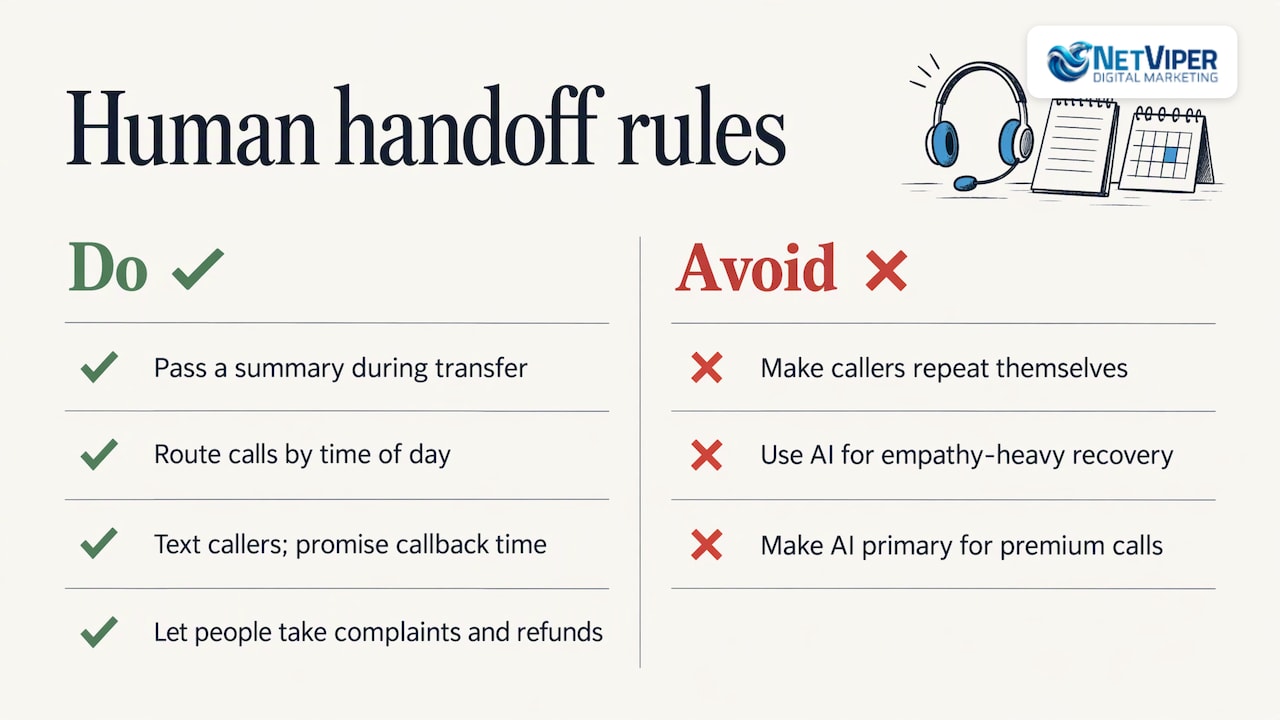
The hand-off is where most systems fail. COPC’s 2025 customer research found that the transition from AI to a human agent is the most frequent point of failure across all six markets it studied, and that in the United States, full resolution after a failed AI interaction occurred only about half the time. The lesson is practical: design the transfer first. Pass along a summary so the caller does not repeat themselves, route by time of day, and set a fallback such as a text message and a promised callback time when nobody is available.
Emotion is the second trigger. A peer-reviewed study in the Journal of Business Research found that customers see a provider as less customer-oriented when AI handles service recovery, and the effect appears when the situation needs real empathy. Complaints, apologies and refunds belong with your people. Scheduling, intake and questions do not need that.
High-value calls deserve the same thought. Bessemer’s roadmap gives the example of a small roofing company that might use an agent for after-hours calls but move slowly toward making it the primary answering service when each call could be a $30,000 project. A sensible pattern: let the agent take every call after hours, and during business hours let it handle overflow while your team takes the premium conversations.
What voice AI does for your numbers
Andreessen Horowitz’s May 2024 thesis on AI voice agents lists three business benefits: time and labor cost savings from human callers, the chance to re-allocate resources toward revenue generation, and reduced risk through more compliant and consistent customer experiences.
In a local business, those translate into measurable results:
- More answered calls. Every call that used to hit voicemail gets a conversation.
- Faster speed to lead. The caller hears a reply at once rather than hours later.
- Staff time back. Your front desk or technicians stop answering the same five questions.
- Consistent intake. Every caller is asked the same qualifying questions, and every answer is recorded.
Customer sentiment supports the approach when it works. COPC’s research, published in January 2026, found that 74% of customers worldwide reported satisfaction with their most recent AI interaction, rising above 90% when the AI fully resolved the issue. The same research found that customers who knew they were talking to AI reported satisfaction 34 percentage points higher than those who were not told. Telling callers up front is the better practice for trust, and in some places it is also the law.
What voice AI costs
Voice AI pricing generally combines a monthly platform or service fee with a one-time setup. Some platforms add charges based on call minutes or call volume, plus any phone-number or telephony costs, so ask for the full monthly picture before you compare options. Setup is where integration with your calendar, CRM and phone system happens, so it is worth budgeting for.
Here is how our own published pricing is structured:
| Item | Price | What it covers |
|---|---|---|
| NV AI Pro Agent | $497 per month | Ongoing AI agent service |
| AI Receptionist setup & deployment | $997 one-off | Getting the receptionist deployed |
| Full Digital Program | $1,995 per month, plus $2,500 one-off set-up fee | Our full digital marketing program |
A useful way to judge any price: divide it by the value of one booked job. If an average customer is worth several hundred dollars and the agent books even a few extra appointments a month that would have gone to voicemail, the monthly fee is a small fraction of the return. Our guide to the AI receptionist for small business goes through what it does and costs in more detail.
Compliance checklist for U.S. businesses
Three separate obligations apply, and none of them is hard to meet if you plan for them before launch. This is general information, not legal advice. For your specific situation, talk with a business attorney.
- Outbound AI calls. In February 2024 the FCC ruled that AI-generated voices count as an artificial or prerecorded voice under the Telephone Consumer Protection Act (TCPA), which means outbound AI-voice calls need prior express consent, identification and opt-out rights, as summarized by a voice AI testing firm.
- Call recording. State laws differ. The same summary notes that 13 states, Florida among them, require everyone on the call to be informed and agree before recording. If you record or transcribe calls in Florida, the agent should say so at the start of the call.
- AI disclosure. California’s AB 2905 requires callers to be told they are speaking with an AI. Even where no law applies, a short opening line such as “You’ve reached the virtual assistant for your business name” fits best practice and matches the satisfaction finding above.
Put the consent and disclosure wording in the agent’s opening greeting, and keep a record of your call-handling policy.
How to measure whether it works
At launch, set targets and review them weekly for the first month. Geodesic notes that traditional software testing is inadequate for voice AI and that teams should track multiple measures, including hallucination rate and turn-level latency (the pause between a caller finishing and the agent answering). For a local business, a practical scorecard looks like this:
- Answer rate: the share of inbound calls the agent picks up.
- Booking rate: calls that end in a scheduled appointment.
- Hand-off success: transfers that reach a person or end in a confirmed callback.
- Caller drop-off: callers who hang up mid-conversation.
- Reliability: dropped calls, wrong answers and long pauses. Bessemer lists dropped calls, made-up answers, high latency and frustrated callers hanging up as the typical complaints, which is why listening to call recordings every week early on pays off.
- Revenue per call source: the jobs won from calls generated by ads and Google Maps listings.
One more finding is worth knowing. Phys.org’s September 2026 report on customer service research found that after a service problem, a text-based chatbot sometimes produced more favorable responses than a voice bot, because writing is slower and gives customers time to calm down. That is a reason to run voice and text together: voice for calls, chat for the website, and a person for upset customers.
A simple rollout plan
- Map your missed calls. Pull a week of phone logs and mark when and why calls went unanswered.
- Pick the first job. After-hours booking is the easiest.
- Write the approved answers. Services, areas, hours, price ranges and policies.
- Connect calendar and CRM. Bookings should appear without manual entry.
- Set hand-off rules and greeting. Include the recording and AI disclosure.
- Launch to after-hours, then expand. Add overflow, then business-hours coverage as results justify.
- Review calls weekly. Tighten answers and adjust transfers.
Because calls often start from advertising, it helps to line this up with your lead sources. A Google Ads campaign or local SEO work for Google Maps brings in the calls, and voice AI makes sure they are answered. A landing page with a click-to-call button sends the right callers to the agent.
Voice AI at NetViper Interactive
We are a Northeast Florida agency, and our AI automation tools, chatbots and voice agents are built so businesses never miss a lead. Our NV AI Pro Agent is listed at $497 per month, and AI Receptionist setup and deployment at $997 one-off. If you also want the calls themselves, our Google Ads management, local SEO and Facebook advertising can sit in the same program.
To see which calls your business could capture first, contact us through our site and we will walk through your phone workflow.
Our perspective
Most local business owners we talk to do not have a calls problem. They have an answered-calls problem. They pay for Google Ads, they work on their Google Maps ranking, and then the phone rings at 7 p.m. and no one is there.
That is why we put AI automation next to advertising and SEO instead of treating it as a separate gadget. Traffic is only worth what you convert, and conversion starts with answering fast. A voice agent that picks up instantly, books the appointment and passes the details to your team turns marketing spend into jobs.
Our advice is to start narrow: after-hours calls, one clear job list, a handoff to your people for anything sensitive. Get that right, measure it, and then expand. Combined with a strong local presence, that is how a Northeast Florida business captures the demand already looking for it.
Dave Fogel
FAQ
Is voice AI the same as an AI receptionist?
An AI receptionist is a common business use of voice AI. It answers the phone, handles routine questions, books appointments and passes details to your team. Voice AI is the underlying technology, and it can also power outbound calls and call screening.
Will callers know they are talking to AI?
They should be told. COPC’s research found higher satisfaction among customers who knew they were speaking with AI, and California requires disclosure. A short greeting that names the virtual assistant is enough.
Can voice AI replace my staff?
It takes the repetitive calls so your staff can spend time on the conversations that need judgment and empathy. Geodesic’s primer describes human agents working alongside AI, handling edge cases and evaluating performance. Complaints, high-value quotes and sensitive conversations stay with your team.
What should I do first to add voice AI to my phones?
Review a week of missed calls, choose one job for the agent such as after-hours booking, and connect it to your calendar. Write the greeting with recording and AI disclosure included, and set a transfer rule for upset callers.
Sources
- Roadmap: Voice AI, Bessemer Venture Partners
- Voice AI: The Enterprise Primer for Strategic Deployment, Geodesic
- Hi, AI: Our Thesis on AI Voice Agents, Andreessen Horowitz
- How Consumers Feel About AI in Customer Service, COPC
- The feeling skills gap: the role of empathy in voice-driven service, Journal of Business Research
- Human-like AI not always the answer in customer service, Phys.org
- Testing Call Recording Consent in Voice AI Agents
- AI sales agents funding news
Recommended

Voice AI for Business: Where It Pays Off and How to Start
Voice AI answers calls, books appointments and follows up with leads around the clock. Learn where it works, what to check first, and how a local business starts.

Local Reputation Management: A Practical Guide for Local Businesses
Learn how local reputation management works: claim your profiles, earn reviews within platform rules, handle negative reviews, and measure results.

Local Business Lead Generation: A Practical Guide for 2026
How local businesses generate leads: Google Business Profile, local SEO, Google Ads, Facebook ads, fast follow-up and AI, with a simple plan to start.
