
Local business lead generation is the work of turning nearby strangers into people who raise their hand: they call, fill out a form, book an appointment or send a message. The reliable approach has four parts. Show up where local customers search (Google Maps and Google search), run targeted ads, give visitors an easy way to act, and respond to every inquiry fast. This guide covers each part, including how to get better leads from Facebook ads.
TL;DR
- Lead generation means getting people to share their contact details or request service. Local lead generation does this within a defined geographic area, according to Google’s guide for local businesses.
- Start with a complete Google Business Profile, consistent listings and reviews. Add geo-targeted Google Ads when you want leads faster.
- Facebook ads produce better leads when the form asks one qualifying question and the lead goes straight to your team or CRM.
- Measure cost per lead, lead quality and lead-to-customer rate. Raw lead volume misleads.
- Speed of response and after-hours coverage often decide who wins the job. AI chat and voice tools can cover the gaps.
Table of Contents
- What local lead generation actually is
- The main channels for generating local leads
- Win the map: Google Business Profile and local SEO
- Capture people already searching: Google Ads
- Facebook ads: how to get better leads, not just more
- Turn clicks into leads: your website and landing pages
- Follow up fast and qualify well
- Use AI so no lead goes unanswered
- Our perspective
- How NetViper can help
- A simple 30-day plan to start
- FAQ
- Sources
What local lead generation actually is
Google’s U.S. guide describes a lead as a stranger who has shown interest, for example by submitting contact information. A lead becomes a conversion when that person pays you. Local lead generation applies the same idea to one city, county or service area.
That geographic limit changes the playbook in three ways:
- Intent is higher. Someone searching for a service near them usually wants to act soon.
- Your pool is finite. You are not chasing the whole internet, so every missed call costs you a real, nearby customer.
- Proximity signals matter. Maps rankings, reviews, citations and service-area targeting carry more weight than they do for national brands.
For a Northeast Florida plumber, dentist, law office or HVAC company, the goal is simple: be visible to the person in Jacksonville, St. Augustine or Nocatee who needs you today, and make it effortless for them to reach you.
The main channels for generating local leads
Google’s guide lists content marketing, social media marketing, local SEO, geographically targeted Google Ads and, for eligible businesses, Local Services Ads as the core online options. Here is how they compare in practice.
| Channel | Speed to first leads | Cost pattern | Best for |
|---|---|---|---|
| Google Business Profile and local SEO | Weeks to months | Retainer or project | Steady, compounding visibility in Maps and search |
| Google Ads (Search) | Days | Pay per click, plus management | Capturing people already searching |
| Local Services Ads | Days after verification | Pay per lead | Eligible service businesses |
| Facebook and Instagram ads | Days | Pay per impression or lead | Creating demand, promotions, offers |
| Website and landing pages | Ongoing | One-time build plus optimization | Converting every channel’s traffic |
| AI chat, voice and text-back | Immediate once set up | Monthly plus setup | Never missing a lead after hours |
Most local businesses do best with a mix: a foundation of local SEO, one paid channel that matches how customers buy, and a conversion layer that captures and answers every lead.
Win the map: Google Business Profile and local SEO
For many local searches, the map results are the first thing a buyer sees. A secondary report of the SOCi Consumer Behavior Index, cited by IvyForms, says businesses in Google’s local map pack received 126% more traffic and 93% more actions than those ranked fourth through tenth. Treat that as directional, but the point holds: position in the map pack matters.
Google’s own guidance says local SEO can include completing your Google Business Profile, encouraging positive reviews, optimizing your website and creating content around local keywords. A practical checklist:
- Complete every field. Accurate primary category, hours, phone number, services and photos, as IvyForms recommends.
- Keep your name, address and phone number identical everywhere. HubSpot’s local lead guide names citations and consistent contact information among the signals behind local search visibility.
- Ask for reviews consistently. Make it part of job completion, not an occasional push.
- Build local pages and content. Service pages for each area you serve, mobile-friendly layouts and internal links between them.
- Earn local links and mentions. Chambers of commerce, local associations and neighborhood publications all count. Looking at how a site covers local businesses in Southern California shows the kind of locally focused content that earns attention from nearby audiences.
If you want a deeper walk-through of the directory side, our guide to local listings management explains what to claim, how to keep it consistent and how to avoid duplicate listings.
Capture people already searching: Google Ads
Search ads put you in front of people at the moment they type “emergency roof repair” or “family dentist near me.” Google notes that visibility for geo-targeted campaigns depends partly on bid keywords, ad copy quality, bid strength and geographic location. That tells you where to focus: tight location targeting, keywords that signal buying intent and ads that match the landing page.
A few habits separate profitable local campaigns from expensive ones:
- Target the area you actually serve. Radius and ZIP-level targeting keep spend from leaking outside your service territory.
- Send each ad group to a matching page. A generic home page loses the click. Our landing page guide covers what a converting page contains.
- Track calls, not just clicks. For most local services, the phone is the conversion. Call tracking shows which keywords and ads produce calls worth answering.
- Diagnose before you cut budget. If clicks arrive but leads do not, the cause is usually tracking, targeting or the page. See how to find and fix Google Ads that are not converting.
Search campaigns or Local Services Ads?
Search Engine Land explains that Local Services Ads are pay-per-lead and largely automated after verification, while Search campaigns give more control over keywords, ad copy and optimization. The same article suggests judging both by cost per lead, lead quality and lead-to-customer conversion rate, not volume alone. Many service businesses run both and compare the results in their CRM. If you are eligible, our page on Local Services Ads management explains how to run them.
What the conversion numbers say
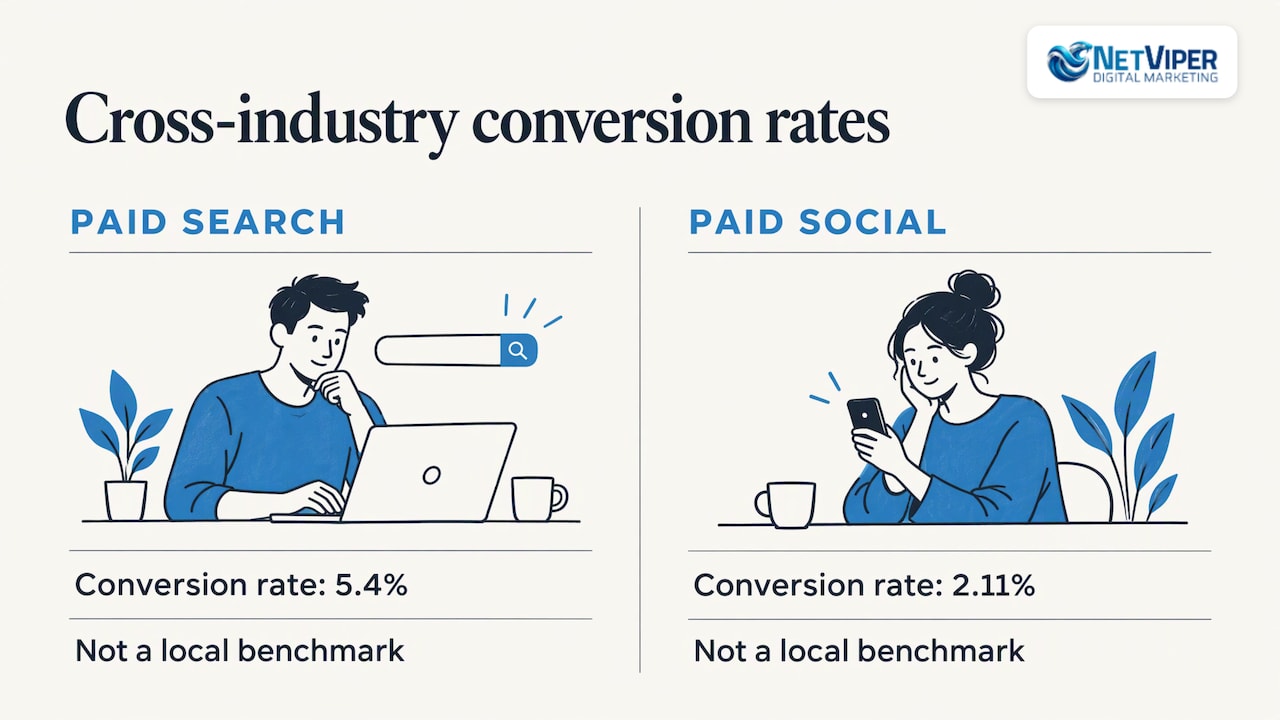
An independent 2026 report from Angarum Media, summarizing Ruler Analytics data on more than five million tracked conversions, found paid search averaged a 5.4% conversion rate versus 2.11% for paid social across industries. These are cross-industry averages, not local benchmarks, but they match what intent suggests: people searching convert at a higher rate than people scrolling. That is why many local businesses pair search with social, using search to harvest demand and social to create it.
Facebook ads: how to get better leads, not just more
Facebook and Instagram ads let you target by location and interest, which makes them good for promotions, seasonal offers and reaching people before they start searching. The common complaint is lead quality: forms that fill fast but produce unanswered phone calls. Quality comes from three layers, as Fluentx lays out: the ad attracts the right intent, the form qualifies without unnecessary friction, and the conversion signal tells Meta which leads are valuable.
Practical steps:
- Add one qualifying question. Zapier’s roundup of expert practices recommends a single strategic question that predicts buying intent, such as when the person needs the work done, while keeping the form short.
- Ask questions one at a time. Fluentx suggests an easy intent question first, then problem or goal, fit, budget or timeline, and finally the contact step. Cold social traffic is interruption-based, so a long form shown all at once creates friction.
- Use form protections. LeadsBridge notes that Meta lead forms can use email validation, conditional questions and real-time delivery to a CRM or webhook to reduce fake or low-fit leads. Availability can vary by account.
- Optimize toward a real outcome. Zapier’s guide on Meta’s Conversions API says to choose a mid-funnel event, such as a qualified lead or completed discovery call, completed by roughly one-third to one-half of your leads, rather than raw form submissions.
- Call the lead quickly. A form submission is a cold signal that gets colder by the minute.
For local targeting and creative ideas, see our guide to local Facebook advertising and our overview of whether Facebook ads are worth it.
Turn clicks into leads: your website and landing pages
Every channel above sends people to the same place, and a weak page wastes all of it. HubSpot describes landing pages as converting visitors by pairing a clear lead form with an offer, such as a discount or free consultation.
What a local landing page needs:
- One clear promise and one primary action, whether that is call, book or request a quote.
- A short form. Keystone recommends roughly three to five fields: name, phone, email, requested service and preferred appointment window, plus the lead source captured behind the scenes.
- A tap-to-call button that is visible on mobile without scrolling.
- Local proof: reviews, service areas, photos of real work and recognizable neighborhood names.
- Fast loading and clean mobile layouts.
If your site is the bottleneck, our approach to conversion-focused web design for local businesses and landing page optimization is built around lead capture and appointment booking.
Follow up fast and qualify well
Generating the lead is half the job. The other half is what happens in the next few minutes. Keystone’s playbook recommends responding within 60 seconds by SMS or a call. Few small teams can do that by hand during a job, which is why automation matters.
A simple qualification routine, adapted from a 2026 practitioner guide, sorts leads by:
- Service area: can you reach them?
- Service need: is it work you do?
- Urgency: today, this week or just browsing?
- Budget or scope: is it in range?
- Detail given: specific requests usually signal serious buyers.
Route the best-fit leads to a person first. Then track outcomes. Search Engine Land recommends using a CRM and call tracking to qualify leads and compare lead quality and lead-to-customer conversion across ad formats, and disputing invalid Local Services Ads leads. Without that loop, you cannot tell which channel is working.
Use AI so no lead goes unanswered
Thryv’s guide for small businesses says AI chat, forms and missed-call text-back can capture inquiries when staff are unavailable. It also says AI can acknowledge requests, answer routine questions, guide scheduling and run later email or SMS follow-up.
To make it work for a local service business:
- Connect the tool to your real services, areas, hours, pricing guidance, FAQs and calendar.
- Set clear handoff rules to a human for high-value jobs, emergencies, complaints and anything the AI is unsure about, as Seekadu advises.
- Review conversations regularly and tighten the answers.
This is the gap we built our AI tools around: chatbots and voice agents that respond instantly, so a call at 9 p.m. or a form fill during a job still gets an answer.
Our perspective
Most local businesses we talk to do not have a traffic problem first. They have a leak problem. Ads bring clicks, the profile brings calls, and then half of those inquiries go unanswered because the owner is on a job site.
That is why we treat lead generation as one system. Local SEO and Google Business Profile work build the visibility that compounds. Google Ads and Facebook ads add demand on a schedule you control. Custom landing pages and smart websites turn that attention into booked appointments. And AI chatbots and voice agents make sure every lead gets an instant response, day or night.
We also believe local markets reward focus. Working with Northeast Florida businesses means we know the neighborhoods, the competition and the seasons. Our certified Google Ads and conversion specialists work directly with owners, and our local SEO approach includes territory locking, so we do not compete against our own clients for the same area.
Our advice: do not judge any channel by lead volume. Judge it by booked jobs and revenue, and build tracking so you can see it.
Dave Fogel
How NetViper can help
If you would rather hand this to a team, we build and run the full system for local businesses in Northeast Florida. Our published pricing gives you a clear starting point:
- GeoBoost 25: local SEO at $497 per month. GeoBoost 100 is $1,697 per month.
- NV AI Pro Agent: $497 per month, with AI Receptionist setup and deployment at a one-time $997.
- Full Digital Program: $1,995 per month with a one-time set-up fee of $2,500.
- Listings & Citations: $60 per month.
Google Ads management, Facebook advertising, landing pages and website design are quoted to fit your market and goals. Start with our Google Ads management or Facebook Ads Manager pages, or explore everything on the all services page.
A simple 30-day plan to start
- Week 1: Fix the foundation. Complete your Google Business Profile, audit your name, address and phone number across listings, and set up call and form tracking.
- Week 2: Build the landing page. One page per core service with a short form, a tap-to-call button and local proof.
- Week 3: Launch one paid channel. Search ads for high-intent services, or Facebook ads for a promotion. Keep the budget focused on your service area.
- Week 4: Close the response gap. Set up text-back, chat or an AI receptionist, and define who handles which leads.
- Ongoing: Review monthly. Compare cost per lead, lead quality and lead-to-customer rate by source, then move budget to what produces booked work.
FAQ
How do I generate leads for a local business with a small budget?
Start with what costs the least: a complete Google Business Profile, consistent listings and a steady flow of reviews. Add one tightly targeted paid campaign for your most profitable service rather than spreading money across channels. Make sure every inquiry gets a fast reply, since that costs nothing and protects the leads you already pay for.
Are Facebook ads good for local lead generation?
They can be, especially for promotions and offers that reach people before they start searching. Quality improves when the lead form includes a qualifying question and leads go straight to your team or CRM. Search ads generally capture people with more immediate intent, so many local businesses run both.
How fast should I respond to a new lead?
As fast as you can. One 2026 playbook recommends responding within 60 seconds by SMS or a call. Automated text-back, chat or an AI receptionist can cover the moments when your team is busy or closed.
How do I know if my leads are good?
Track what happens after the form or call: did it become a booked job, and what revenue did it bring? Use a CRM and call tracking to compare sources. Search Engine Land recommends judging channels on cost per lead, lead quality and lead-to-customer conversion rather than volume.
Sources
- Guide to lead generation for local businesses, Google Ads
- Local Lead Generation: The Tips, Tricks, and Tools, HubSpot
- Lead Generation for Local Businesses: Why Radius Beats Reach, IvyForms
- The 2026 Lead Generation Report, Angarum Media
- Google Local Services Ads vs. Search Ads, Search Engine Land
- Facebook lead ads: 6 best practices from experts, Zapier
- Facebook Conversions API: A guide to better lead quality, Zapier
- How to avoid fake leads from Facebook Ads, LeadsBridge
- How to improve Meta Ads lead quality with forms and CAPI, Fluentx
- From First Click to Booking: A 7-Step Playbook, Keystone
- Lead Generation Using AI: A Guide for Small Businesses, Thryv
- How to Stop Losing Leads After Hours, Seekadu
- Local businesses in Southern California
Recommended
Local Business Lead Generation: A Practical Guide for 2026
How local businesses generate leads: Google Business Profile, local SEO, Google Ads, Facebook ads, fast follow-up and AI, with a simple plan to start.
Google Ads Conversion Tracking: Setup and Fixes for 2026
Set up Google Ads conversion tracking step by step, check that it records accurately, and fix the common reasons conversions stop tracking.
Google Business Profile Management: What It Covers and How to Do It Well
Google Business Profile management explained: how to claim, edit and maintain your listing, handle reviews and users, and what a management service should include.
