
Paid search management is the ongoing work of planning, launching, measuring and improving the ads your business pays for on search engine results pages, most often Google Ads. A manager handles keywords, bids, ad copy, landing pages and conversion tracking so that your budget buys calls, form fills and bookings instead of idle clicks. This guide explains what that work involves, how the auction behind it operates, which numbers prove it is working, and what a local business should expect to spend.
TL;DR
- Paid search management means running search ads (also called PPC) toward a business outcome: leads, calls, bookings or sales. It is not just “setting up” an account.
- A manager sets goals, builds tightly themed ad groups, chooses keywords and bids, writes ads, matches them to landing pages, then reviews and tests continuously.
- Judge the work by conversions, cost per conversion and return on ad spend, not by clicks alone.
- $500 a month can be a workable test budget for a local or niche business, but it may fall short in expensive industries.
- Paid search delivers visibility quickly, while SEO builds over time. Most local businesses do best using both.
Table of Contents
- What paid search management actually means
- What a paid search manager does
- How the ad auction decides who appears
- A pre-launch checklist that prevents wasted spend
- The metrics that show whether it is working
- How much budget do you need? Is $500 a month enough?
- Paid search, SEO and Google Maps: how they fit together
- In-house, freelancer or agency?
- Our perspective: local intent is won after the click
- What management looks like with NetViper
- FAQ
- Sources
What paid search management actually means
The vocabulary around this topic is loose, so it helps to pin it down. Paid search advertising makes your products or services visible on search engine results pages, and it is commonly known as PPC. The industry uses the terms PPC, CPC, paid search and search ads more or less interchangeably, while “SEM” is sometimes used narrowly for paid search and sometimes more broadly for any tactic that increases visibility in search, including SEO.
Management is the layer on top. PPC management can be handled in-house or by an outside consultant or agency, and its purpose is to steer campaigns toward a result such as sales, leads, website traffic or brand awareness. For a local service business, that result is almost always a phone call or a booked appointment.
Why does this need ongoing attention? Because every search ad runs in an auction that changes daily. Competitors adjust bids, search behavior shifts with the season, and a landing page that converted well in spring can underperform by fall. Unmanaged campaigns tend to drift toward spending money on searches that never turn into customers.
What a paid search manager does
If you have wondered what a paid search manager does day to day, the work breaks into a repeatable cycle. Search Engine Journal describes PPC management as creating, executing and optimizing a brand’s PPC strategy, covering keyword and audience research, competitive analysis, channel selection, ad creation, budget monitoring, landing-page optimization, reporting and testing.
In practice, a campaign moves through these stages:
- Set the goal. Decide what a conversion is: a call, a form submission, a booked estimate. Everything else is built backward from that.
- Structure ad groups. Search Engine Land recommends grouping closely related themes, naming ad groups descriptively and assigning relevant keywords and ads to each. A plumber, for example, should not put “water heater repair” and “drain cleaning” under one ad.
- Choose keywords and targeting. This includes match types, negative keywords that block irrelevant searches, and the geographic area you actually serve.
- Set bids and budget. The manager picks a bidding strategy suited to the goal and a daily budget you can sustain.
- Write ads and assets. Headlines and descriptions should echo what the searcher typed and promise what the landing page delivers.
- Select landing pages. The click is paid for; the page earns the conversion.
- Launch, then review and iterate. The same guide frames optimization as an ongoing loop of testing and iteration, not a one-time setup.
The part owners underestimate is step 7. Most of the value in a managed account comes months after launch, from search term reviews, negative keyword additions, ad tests and budget reallocation toward what converts.
How the ad auction decides who appears
Understanding the auction helps you ask better questions of anyone managing your account. According to Google’s documentation, the system first interprets the search, then retrieves enabled keywords that are relevant and checks match type and eligibility. Eligibility covers budget, geotargeting, audience targeting, negative keywords, approved creatives and landing pages, and time restrictions. Google then selects a candidate ad and bid, and sends the highest-Ad-Rank ad from each advertiser into the auction.
Two things follow for a business owner:
- You do not simply buy the top spot. Ad Rank blends your bid with the quality and relevance signals around your ad, which is why a well-built campaign can beat a larger budget.
- You rarely pay your maximum. The maximum CPC bid is the most you are willing to pay for a click, while the actual CPC is often lower and depends on the auction.
Bidding itself is increasingly automated. Google’s Smart Bidding uses machine learning at auction time. Maximize Conversions aims for the most conversions, Target CPA adds a cost-per-acquisition target, Maximize Conversion Value targets value, and Target ROAS adds a return target. Which one fits depends on your objective: volume, acquisition cost, value or return. Automation does not remove the need for a manager. It moves the work to feeding the system accurate conversion data and sensible targets, which is why conversion tracking comes before anything else.
A pre-launch checklist that prevents wasted spend
Before a campaign goes live, Semrush recommends checking campaign settings, URLs and ad assets, then monitoring CTR, conversion rate and average CPC to guide changes to bids, keywords and copy. Here is the checklist we would run on a local account:
- Conversion tracking fires correctly. Test a call, a form and a booking. A campaign that cannot see its conversions cannot optimize toward them.
- Location settings match your service area. A Jacksonville contractor does not want clicks from across the state.
- Negative keywords are loaded. Block terms like “jobs,” “free” or “DIY” if they do not fit your business.
- Every ad points to a relevant page. Make sure each landing page loads fast on a phone, states the offer clearly and puts the call button or form above the fold. If your page serves products, a sound effective ecommerce layout keeps shoppers moving toward checkout instead of bouncing.
- Budget and schedule are realistic. If you only answer the phone from 8 to 5, ads running at midnight may need a different response plan, such as an automated receptionist.
- Reporting is agreed. Decide in advance which numbers you will review monthly.
If your landing page is the weak link, our landing page optimization work and our Smart Website builds focus on lead capture and appointment booking, so the traffic you pay for has somewhere to convert.
The metrics that show whether it is working
Clicks feel like progress, but they are not the goal. Google Ads Help names conversions as among the most important metrics for Search campaigns because they measure actions valuable to your business. The most direct measures are conversions, conversion rate, conversion value, cost per conversion and ROAS. Clicks, CTR and average CPC are supporting metrics that explain why the main numbers move.
Here is how the common definitions line up, drawing on HubSpot’s PPC guide:
| Metric | What it tells you | How it is calculated |
|---|---|---|
| CTR | Whether your ad earns the click | Clicks divided by ad views |
| Conversion rate | Whether your landing page closes | Visitors who complete the call to action, as a share of visitors |
| Cost per conversion | What a lead or sale costs | Total ad cost divided by conversions |
| ROAS | Revenue per advertising dollar | Revenue received divided by ad spend |
For local services, Google also tracks local actions conversions such as directions requests, website visits, menu views and clicks to call. For a restaurant or a clinic, those are often the real signals of intent.
Return on investment comes down to comparing what each conversion is worth with what you spent. Google’s own example is simple: spend $10 and earn a $15 sale, and you have produced $5. The same logic works for a service business. If a booked job is worth $800 in gross profit and a lead costs $100 to acquire, even a modest close rate leaves room for profit.
Be cautious with benchmarks. Search Engine Journal’s Navah Hopkins notes that useful benchmarks vary with competition, geography, industry and account age, and she advises reading CTR together with conversion rate and conversion quality rather than leaning on any single number. A manager who quotes you one universal “good” CTR is oversimplifying.
How much budget do you need? Is $500 a month enough?
This is the question we hear most. There are two separate costs: what you pay Google for clicks, and what you pay someone to manage the account.
Ad spend. Google states that its US platform has no flat fee or monthly subscription; Search ads generally use CPC pricing, and you set an average daily budget or a campaign total budget. Google adds that budget caps can limit your chances of reaching more customers. Its budget guidance says the right amount depends on your marketing goals, your industry and what you are willing to spend per customer.
So is $500 enough? One industry publication says it can be a useful test budget for local or niche businesses but may be inadequate in high-cost industries. Here is simple arithmetic to show why, using made-up numbers for illustration, not benchmarks. If your average click costs $5, $500 buys about 100 clicks. If 5 percent of visitors call or submit a form, that is about 5 leads, or roughly $100 each. If your average job is worth $150, that is a losing test. If it is worth $2,000, it may be a very good one. Cost per click in your category and the value of a customer decide the answer, not the round number.
A few practical points for a small budget:
- Focus on one service and one service area rather than spreading thin.
- Use tight keyword themes and negative keywords so every dollar goes to buyers.
- Treat the first 60 to 90 days as a learning period with a decision point, not a verdict after two weeks.
- Fix the landing page before raising the budget. Doubling spend on a page that converts poorly doubles the waste.
Management fees. Agencies typically charge a monthly retainer, and some add a one-time setup fee. Our published pricing is on our digital marketing pricing page, and it is covered in the promo section below.
Paid search, SEO and Google Maps: how they fit together
Paid search and SEO answer the same searcher in different ways. Search Engine Journal describes SEO as improving a website to earn organic traffic, while PPC uses paid methods to appear in results. Adobe’s comparison says paid search gives immediate visibility for selected queries, while SEO earns visibility through content, optimization and authority over time.
The tradeoff is speed against durability. Semrush notes that PPC can produce conversions faster but may be expensive, whereas SEO takes longer and can keep producing conversions without much additional investment. It recommends considering both.
The two also feed each other. Semrush suggests using paid keyword performance to inform SEO content and treating strong organic pages or long-tail queries as candidates for paid campaigns. In plain terms: the keywords that turn into paid leads show you which pages to build or strengthen organically.
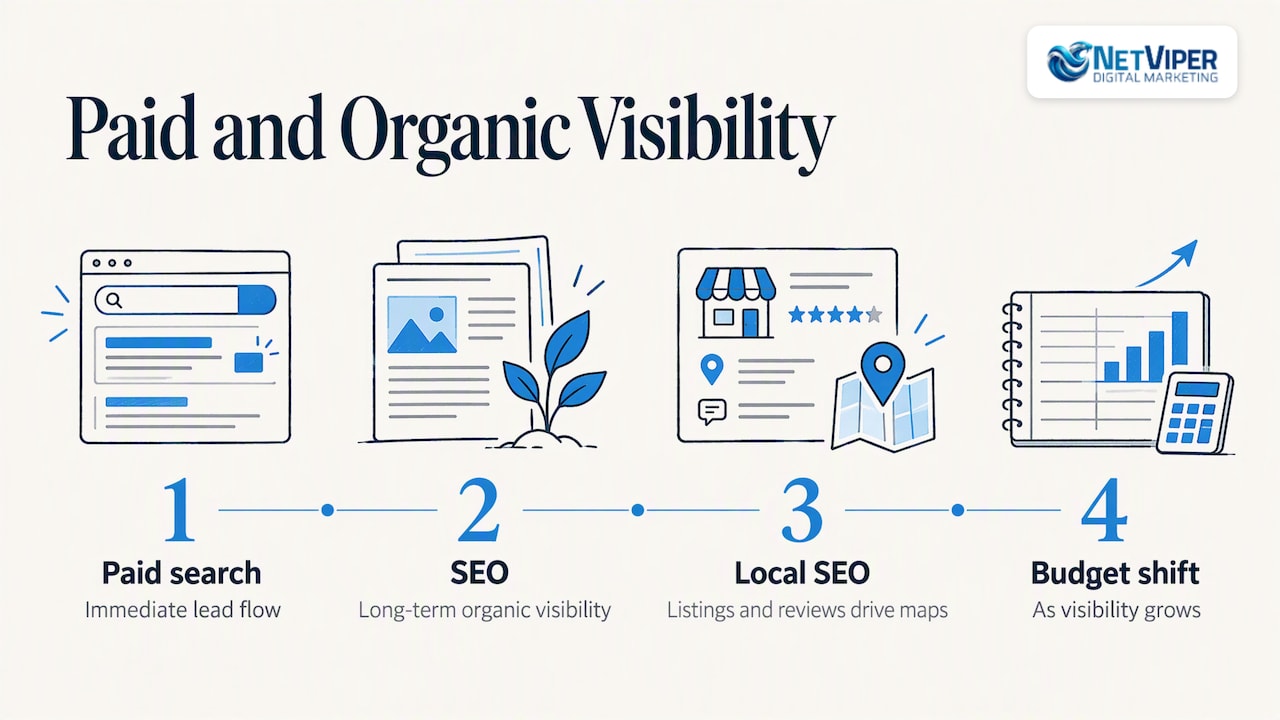
What about Google Maps? Paid search does not replace local optimization. Your Google Business Profile, listings and reviews are what drive map-pack visibility, and that is a local SEO discipline. We handle it through our local SEO services. A sensible local sequence is to run paid search for immediate lead flow while the profile and citations strengthen, then shift budget as organic and map visibility grow.
In-house, freelancer or agency?
There is no single right answer, so compare by type:
| Option | Best for | Watch out for |
|---|---|---|
| In-house (you or an employee) | Owners who enjoy the work and have time to learn it | Hours lost from running the business, slow learning curve, costly early mistakes |
| Freelance specialist | Smaller accounts with a clear scope | Coverage gaps during vacations, limited help with landing pages and tracking |
| Local agency | Businesses that want strategy, ads, pages and tracking handled together | Fees on top of ad spend; you need clear reporting and no long lock-ins you do not understand |
| Hourly coaching or audit | Owners who want to run ads themselves with expert guidance | Requires your ongoing time and discipline |
Whichever you choose, ask who owns the ad account, how conversions are tracked, how often you receive reports and what a typical month of optimization includes. If a provider cannot answer in plain language, keep looking.
Our perspective: local intent is won after the click
We work with local businesses across Northeast Florida, and the pattern is consistent: most paid search problems are not bidding problems. They are leakage problems. The ad is fine, but the call goes to voicemail, the form is buried on a slow page, or nobody tracks which keyword produced the booking.
That is why we manage paid search as part of a lead system rather than a standalone line item. Certified specialists build and tune the campaigns, custom landing pages focus on one action, and AI tools such as chatbots and voice agents respond to inquiries instantly so a lead does not go cold while you are on a job site. We also believe a local business should be able to talk directly to the person managing its money. Territory matters too: we use exclusive local SEO territory locking so we are not working against another of our own clients for the same area.
If you take one idea from this article, make it this: pay for clicks only after you have confirmed you can capture and answer every one of them.
— Dave Fogel
What management looks like with NetViper
We manage Google Ads for businesses in Jacksonville, St. Augustine, Ponte Vedra Beach, San Marco and the surrounding area. You can see how we approach campaigns on our Google Ads management in Jacksonville page, or review our broader Google Ads and PPC services.
Our Full Digital Program is priced at $1,995 per month with a one-time set-up fee of $2,500, and it brings paid ads, SEO and conversion work together under one roof. If you prefer to keep ads in-house, we offer Paid Ads Coaching at $225 per hour and a Conversion Tracking Audit at $175 per hour. If you only want local search help, GeoBoost 25 is $497 per month and GeoBoost 100 is $1,697 per month. Pricing for stand-alone Google Ads management is not published, so contact us with your service area and goals and we will scope it with you.
Once your ads start generating inquiries, our NV AI Pro Agent ($497 per month, plus a $997 one-time AI Receptionist setup and deployment fee) answers them instantly, so fewer leads slip away.
FAQ
What is a paid search manager?
A paid search manager is the person or team responsible for creating, running and optimizing your search ads. That includes keyword research, bidding, ad copy, landing-page recommendations, budget monitoring and reporting. The goal is to turn ad spend into conversions such as calls, leads or sales.
Is $500 a month enough for Google Ads?
It can be, as a test budget for a local or niche business, but it may be too little in expensive industries. The right figure depends on your cost per click, your conversion rate and what a customer is worth to you. Start with one service and one location, then adjust based on cost per conversion.
Which is better, SEO or PPC?
Neither wins in every case. PPC gives you visibility quickly and is measurable, while SEO takes longer to build but can keep producing leads without a per-click fee. Many local businesses use PPC for immediate leads while building organic and Google Maps visibility.
Do I pay Google or the agency for ad clicks?
You pay Google for clicks. Google has no flat fee or subscription for Google Ads, and you set a daily or campaign budget. A management fee to an agency or consultant is separate and covers the work of running the account.
Sources
- A complete guide to search engine marketing (SEM) strategies, Adobe
- Performance Marketing Glossary, PMA
- SEM vs. SEO: What’s The Difference?, Search Engine Journal
- What Is PPC Management?, WordStream
- How matching works, Google Ads Help
- Actual cost-per-click (CPC), Google Ads Help
- How Google Ads calculates bids, Google Ads Help
- How to implement a PPC campaign, Search Engine Land
- What Is PPC Management, Search Engine Journal
- A Guide to Paid Search Ads, Semrush
- Use data to optimize your Search campaigns, Google Ads Help
- About return on investment (ROI), Google Ads Help
- How to Build Pay-per-Click Marketing Campaigns, HubSpot
- How to Measure Success in PPC Campaigns, Search Engine Journal
- How much does Google Ads cost?, Google Ads
- Google Ads Cost Tool, Google
- Is $500 Enough for Google Ads?, PPC Digest
- What PPC Management Is & How to Get Started, Semrush
- Effective Ecommerce Layout: What to Build and What to Skip
Recommended

Chatbot Development for Business: What It Involves and How to Start
Chatbot development for business explained: what a chatbot can do, how projects are built, what to plan for, and how local businesses get one live without the guesswork.

Google Ads Budget: How Much to Spend and How to Set It
Learn how a Google Ads daily budget works, how to calculate a monthly budget from your lead goals, and what a local business should spend to get real data.

Google Business Profile Optimization in Jacksonville, FL
How Jacksonville businesses optimize a Google Business Profile: the steps that move Maps rankings, what to measure, what it costs and when to hand it off.
