
Local Facebook advertising lets you show ads only to people in the cities, ZIP codes or radius around your business, then follow up with the ones who visited your website but did not call or book. Done well, it turns a small, defined service area into a steady stream of leads. This guide covers how to set up local targeting, choose an objective, run retargeting, measure results and stay on the right side of privacy rules.
TL;DR
- Target by city, ZIP code or a radius around your location, and turn off location expansion so ads do not drift outside your service area.
- Pick the campaign objective that matches the action you want, usually Leads or Sales for a service business, not Awareness.
- Retargeting uses the Meta Pixel to show ads to people who already visited your site, and it works best as its own campaign with its own budget.
- Send ad clicks to a focused landing page and track calls and form fills, or you cannot tell what the spend is earning.
- Respect privacy rules such as California’s CCPA/CPRA when you build audiences from website data.
Table of Contents
- Why local Facebook advertising works for service businesses
- How to target a local area in Ads Manager
- Choose the right objective, audience, creative and budget
- How Facebook retargeting works
- Send clicks to a page built to convert
- Measure what matters
- Where Facebook fits in a local advertising mix
- Privacy and policy basics for U.S. advertisers
- Our perspective on local Facebook advertising
- Work with a local team on your Facebook ads
- FAQ
- Sources
Why local Facebook advertising works for service businesses
Most local businesses do not need millions of impressions. They need the right few thousand people: homeowners in a set of ZIP codes, parents within 10 miles of a studio, patients near a clinic. Facebook and Instagram ads let you define that audience by place, then add interests, age or past behavior on top.
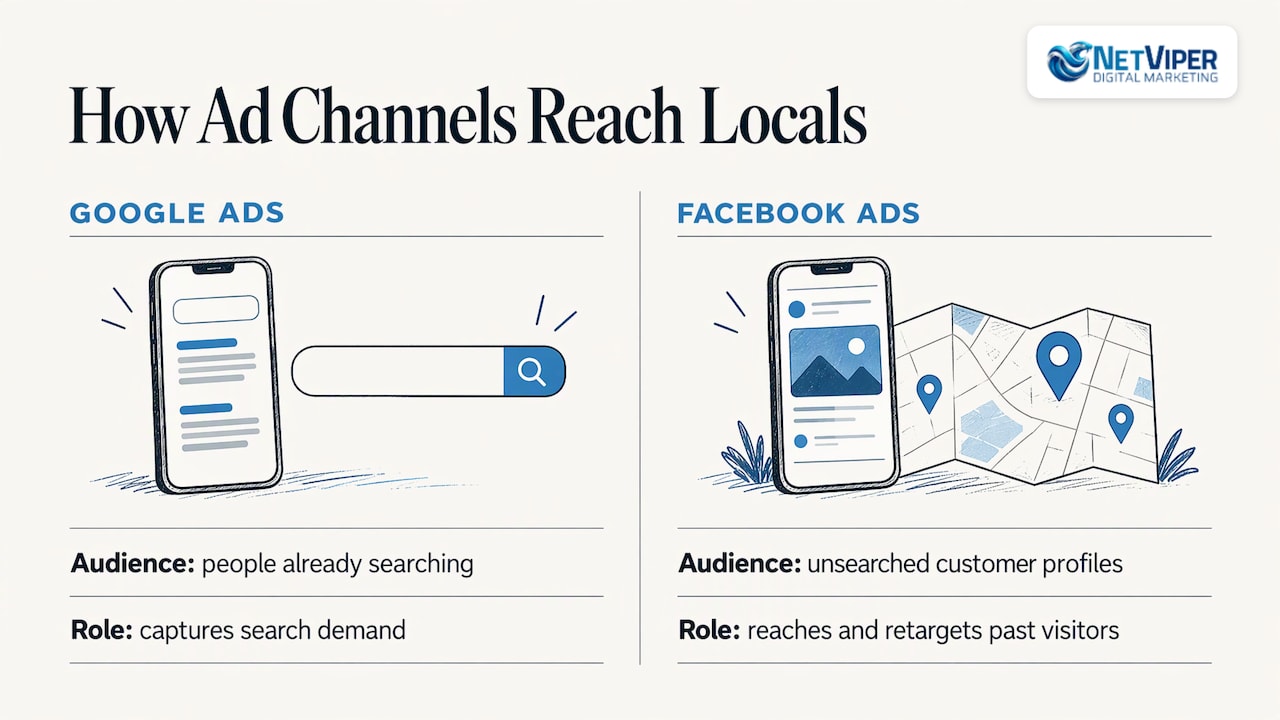
It also fills a gap that search ads leave. Google Ads captures people who are already searching. Facebook ads reach people who have not searched yet but fit your customer profile, and they keep your name in front of people who looked and left. Many local owners run both, and our Facebook Ads Manager service is built to work alongside search campaigns. If you are still deciding whether the channel pays off, our breakdown of whether Facebook ads are worth it and nine reasons Facebook ads are effective go deeper.
Ads appear in more places than the main feed, including Stories, Reels and Instagram. Our guide to where Facebook and Instagram ads appear shows each placement.
How to target a local area in Ads Manager
Location is set at the ad set level in Meta Ads Manager. You can target by country, region, city, postal code or a dropped pin with a radius. According to Variafy’s guide to local Facebook ads, radii run from 17 to 80 km around a city and from 1 to 80 km around your own pin, so a pin on your storefront gives you the tightest control.
A practical approach for a service area:
- Start with the places you actually serve. List the ZIP codes or neighborhoods where you take jobs. A plumber in Jacksonville might use Mandarin, Riverside and Arlington ZIP codes instead of the whole metro.
- Use a pin and radius for storefronts. A restaurant or salon draws from a short drive, so a 5 to 10 mile radius around the pin is often a sensible starting point to test.
- Exclude areas you cannot serve. If a river, county line or travel time limits your crews, exclude those places rather than paying for clicks you cannot convert.
- Choose the right location type. Select people living in or recently in the area, depending on whether you want residents or visitors.
Turn off location expansion
Meta has a setting that can show your ads to people interested in the places you selected, including people elsewhere in the country. Variafy notes that local businesses can switch it off. For a business with a fixed service area, we recommend unticking it so every dollar goes to people you can actually reach.
Choose the right objective, audience, creative and budget
The objective tells Meta what to optimize for. Buffer’s beginner guide lists six: Awareness, Traffic, Engagement, Leads, App Promotion and Sales. Match the objective to the action you want:
| Your goal | Objective to consider | Typical local example |
|---|---|---|
| Phone calls, quotes, appointment requests | Leads | Roofing estimate form |
| Online bookings or purchases | Sales | Class booking, product order |
| Visits to a key page | Traffic | Seasonal promotion page |
| Name recognition in a new area | Awareness | New location opening |
Choosing Traffic or Engagement because the clicks are cheap is a common mistake. Meta delivers what you ask for, so if you ask for likes, you get likes.
Audience
Start broad inside your geography, then layer on detail only if you have a reason. A narrow audience in a small radius can become too small for Meta to optimize. If you have a customer list, upload it as a Custom Audience and build a lookalike from it, then keep the location limits in place.
Creative
Local ads win when they look local. Use real photos of your team, your trucks or your storefront, name the town or neighborhood in the headline, and make a single clear offer such as a free estimate or a first-visit special. Image dimensions matter for placements, and we cover them in our post on popular Facebook ad sizes.
Budget and testing
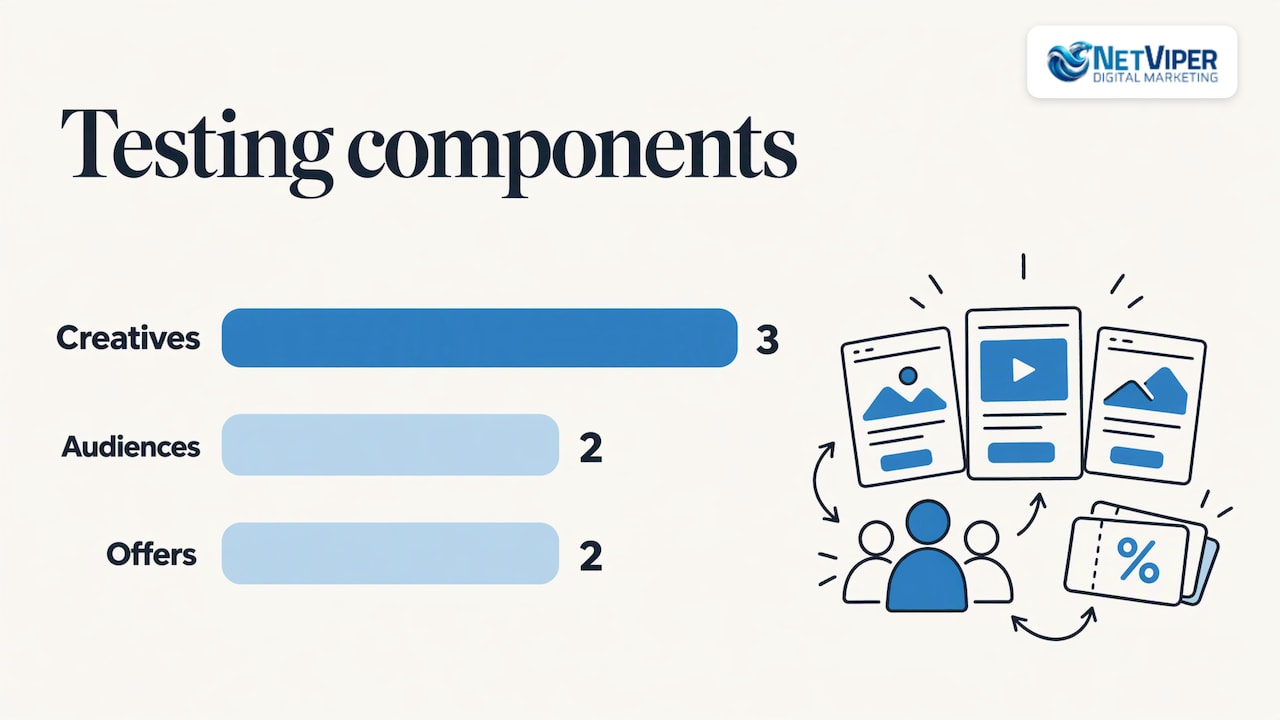
Give each campaign enough budget to gather data before you judge it. A structured testing method helps you avoid guessing. Sprout Social describes the 3-2-2 method as three creatives, two audiences and two offers, which identifies strong combinations without overloading the algorithm. The same logic applies on other platforms, and this walkthrough of structured creative testing shows how to organize experiments so each variable gets a fair read.
How Facebook retargeting works
Retargeting, also called remarketing, shows ads to people who have already interacted with your business. Your website sends visit data to Meta through the Meta Pixel, and Meta groups those visitors into a Custom Audience. According to Meta’s Business Help Center, website custom audiences let you reach people who have already shown interest, and one use case is retargeting people who visited your site in the last 30 days without converting.
That matters for local service businesses because most visitors do not act on the first visit. They compare two or three providers, get distracted and come back later, or never do. A retargeting ad keeps you in the comparison.
Audiences a local business can retarget
- Website visitors: everyone who loaded any page, or only people who viewed a specific service page.
- High-intent visitors: people who reached the contact, pricing or booking page but did not submit.
- Social engagers: people who watched your videos, opened a lead form or interacted with your Page or ads.
- Customer lists: past clients you upload, used for repeat-service offers or referral requests.
SocialPilot’s setup guide outlines the same flow: create a Custom Audience in Ads Manager from Pixel visitors or people who engaged with posts, videos or ads, then launch a campaign aimed at it with a controlled budget.
Set up retargeting website visitors on Facebook
- Install the Meta Pixel on every page of your site, and confirm it fires on your thank-you or confirmation page.
- In Ads Manager, open Audiences and create a Custom Audience from your website, choosing the time window and pages.
- Build a separate campaign for this audience, with its own budget.
- Exclude people who already became customers so you do not pay to advertise to them.
- Write copy for someone who already knows you: a testimonial, a reminder of the offer, or an answer to a common objection.
Marketing specialists writing for small businesses recommend treating retargeting as its own campaign layer with a separate budget and exclusion audiences such as past purchasers, which keeps the message relevant and reduces wasted impressions.
Keep your retargeting pool healthy
Retargeting only works if enough people visit your site in the first place. A small local site may produce a few hundred visitors a month, so pair retargeting with a prospecting campaign, search ads or local SEO that keeps new people arriving. Our local SEO work for Jacksonville businesses feeds the same funnel.
Send clicks to a page built to convert
The ad earns the click. The landing page earns the lead. Sending local ad traffic to a homepage with six menu items and no clear next step wastes budget. A dedicated page should repeat the ad’s offer, show proof such as reviews and photos, and offer one action: call, book or request a quote.
Speed of response matters just as much. A lead who submits a form at 8 p.m. and hears back the next afternoon has often called someone else. Our guide on automated lead follow-up explains how to respond within minutes, and our landing page guide covers layout and copy. If you want a page built for you, see our landing page optimization service.
Measure what matters
Cost per click and reach are easy to read and easy to misuse. For a local business, the numbers that decide whether the campaign is working are:
- Cost per lead: what you pay for each form, call or booking.
- Lead quality: how many of those leads were in your service area and ready to buy.
- Cost per customer: total ad spend divided by new customers won.
- Return on ad spend: revenue from those customers compared with spend.
To capture these, set up conversion events in the Pixel for form submissions, bookings and button clicks, and track phone calls separately. Calls are often the biggest source of local leads, and our article on call tracking for ads shows how to attribute them. Review results weekly, change one variable at a time, and give any new ad set several days before you cut it.
When results stall, the cause is usually one of three things: the offer is weak, the landing page loses people, or follow-up is slow. Fix them in that order, since a better ad cannot rescue a page that does not convert.
Where Facebook fits in a local advertising mix
Facebook is one channel in a wider system, not a replacement for the others:
- Google Ads captures people searching for your service right now.
- Facebook and Instagram ads build awareness, generate leads from people who were not yet searching and retarget visitors.
- Local SEO and your Google Business Profile keep you visible in map results and organic search over the long term.
- Email and text follow-up convert the leads the others produce.
Traditional media can pair well with social too. Seasonal or event-driven promotions often work best when the same offer appears in several places during the same weeks. If you are weighing platforms, our overview of what to expect from a Meta advertising agency explains how Facebook management is usually structured, and our Digital Marketing FAQ answers common budget questions.
Privacy and policy basics for U.S. advertisers
Building audiences from website visitors means you are using personal data, so privacy law applies. In California, the CCPA/CPRA gives residents the right to opt out of the sale or sharing of their personal information. TermsFeed explains that Facebook applies Limited Data Use to users who have opted out, that businesses must provide appropriate CCPA/CPRA notices, and that the business remains solely liable for its own compliance.
In practice, that means:
- Publish a privacy policy that describes your use of the Pixel and advertising cookies.
- Honor opt-out requests and do not pass personal information of opted-out California consumers to Meta except where Limited Data Use is enabled.
- Do not send sensitive information, such as health details, through the Pixel.
If you operate in a regulated field such as healthcare or legal services, ask your attorney to review your tracking setup before you launch. Other states have their own privacy laws, so a lawyer who knows your state can confirm what applies.
Our perspective on local Facebook advertising
We see the same pattern with local businesses in Northeast Florida: the ad itself is rarely what holds results back. The gaps sit around it, in targeting that spills outside the service area, landing pages with no clear action, tracking that misses phone calls and follow-up that arrives hours late.
That is why we build Facebook campaigns as part of a full lead system. We set tight local targeting, separate prospecting from retargeting, send traffic to pages designed for one action, and connect the results to calls and bookings so you can see what the budget produces. Our AI chatbots and voice agents answer leads right away, so a lead from a 9 p.m. ad click is not left waiting.
Our certified specialists work directly with local owners and know how Jacksonville, St. Johns and St. Augustine customers search and buy. We would rather help you make a smaller budget do more than push you to spend more.
Dave Fogel
Work with a local team on your Facebook ads
If you want a team to handle targeting, creative, retargeting and reporting, our Facebook Ads Manager service is built for local businesses in Northeast Florida. Facebook campaigns work well alongside search, SEO and AI lead response, which is how our Full Digital Program is structured: $1,995 per month with a one-time $2,500 set-up fee.
To see how it could fit your service area and goals, visit NetViper Interactive and request a conversation with our team.
FAQ
How much does local Facebook advertising cost?
Costs depend on your industry, audience size and competition, so there is no single figure that fits every business. You set a daily or lifetime budget in Ads Manager and Meta spends it within that limit. Start with a budget large enough to produce a meaningful number of leads in a few weeks, then scale what works.
Can I show ads only to people near my business?
Yes. In Ads Manager you can target by city, ZIP code or a radius around a pin on your location. Turn off location expansion so Meta does not show your ads to people outside the places you chose.
How does Facebook retargeting work?
The Meta Pixel on your website records visits and adds those people to a Custom Audience. You then run ads aimed only at that audience, such as people who viewed a service page but did not contact you. Exclude existing customers to keep the message relevant.
Should I use Facebook ads or Google Ads for my local business?
They do different jobs. Google Ads reaches people actively searching, while Facebook ads reach likely customers earlier and bring back past visitors. Many local businesses get the best results by running both and tracking leads from each.
Sources
- Facebook ads for local businesses: what works
- How to Run Facebook Ads: 2026 Beginner’s Guide
- Facebook marketing for small business: a complete guide
- Scale Faster: Google Ads Creative Testing With Experiments and Persona Tests
- About website custom audiences, Meta Business Help Center
- Facebook Ads Guide: Setup, Best Practices & Tips
- Retargeting & Remarketing for MSMEs: Conversion Recovery
- Facebook Retargeting Under the CCPA (CPRA): What’s LDU?
Recommended
Google Ads Not Converting? How to Find and Fix the Cause
Getting clicks but no leads from Google Ads? Check tracking, wait times, search terms, targeting and landing pages in order to find what is costing you conversions.
Local Facebook Advertising: How to Reach Nearby Customers
Learn how local Facebook advertising works: location targeting, objectives, retargeting website visitors, measurement and privacy basics for local business owners.

Conversion-Focused Web Design for Local Businesses
Learn what conversion-focused web design is, the principles behind it, and how local businesses can turn more website visitors into calls, bookings and leads.
