
A Meta advertising agency plans, builds, runs and measures paid campaigns on Facebook and Instagram, and ties the spend to leads, calls and booked appointments instead of clicks and likes. For a local business, the right agency is the one that controls your tracking, shows you every dollar, leaves the ad account in your name and responds to new leads fast. This guide explains what the work includes, how to judge an agency before you sign, what drives the fees and where AI follow-up fits in.
TL;DR
- A good Meta agency handles strategy, creative, audiences, tracking, testing and reporting, not just “boosting posts.”
- Your business should own the ad account and the Meta Pixel data. The agency gets partner access to it.
- Targeting is increasingly automated, so results depend on clean conversion tracking and strong creative.
- Fees depend on scope, number of campaigns, creative volume and tracking work. Ad spend is paid to Meta separately.
- Fast lead response matters as much as the ad. Chatbots and AI receptionists help you capture leads after hours.
Table of Contents
- What a Meta advertising agency actually does
- When hiring an agency makes sense
- How a Meta agency plans, launches and optimizes campaigns
- How to evaluate an agency before you sign
- What Meta agency support costs, and what drives it
- How to measure whether Meta ads are working
- Where AI fits: lead follow-up after the click
- Our perspective: ads, local search and follow-up work together
- How NetViper Interactive can help
- A quick checklist before you hire
- FAQ
- Sources
What a Meta advertising agency actually does
Meta runs the ad system behind Facebook, Instagram, Messenger and its partner network. An agency is a team that operates that system for you. The work is broader than most owners expect, and it usually falls into six parts.
- Strategy and offer. Choosing the goal (calls, form fills, store visits, bookings), the audience and the offer that gives a cold viewer a reason to act.
- Account structure. Setting up campaigns, ad sets and ads so budget goes where results come from, and so you can read the data later.
- Creative. Writing copy, choosing images and short video, and producing the formats each placement needs. See our guide to popular Facebook ad sizes and where Facebook and Instagram ads appear.
- Tracking. Installing the pixel and server-side events so Meta and you can see which ads produce leads.
- Testing and optimization. Running controlled creative and audience tests, then shifting budget toward what works.
- Reporting. Translating platform numbers into cost per lead, cost per booked appointment and return on ad spend.
One independent specialist puts the current division of labor this way: Meta’s algorithm now does most of the targeting, while agencies focus on conversion events and creative. That matches what we see in local accounts. Hand-built interest lists matter less than they did. What you feed the system matters more.
Services you can expect across Facebook and Instagram
A full-service Meta engagement for a local business typically covers:
- Lead generation campaigns with forms inside Facebook and Instagram or sent to a landing page
- Retargeting of website visitors, past leads and people who engaged with your content
- Local awareness campaigns aimed at a radius around your service area
- Click-to-message campaigns that open a Messenger or Instagram conversation
- Creative production and refresh cycles
- Conversion tracking setup and audits
- Monthly reporting and a strategy call
If you want the details of how we run this for local companies, see our Facebook Ads Manager service.
When hiring an agency makes sense
You can run Meta ads yourself, and some owners do it well. An agency starts to pay off when one or more of these is true:
- You spend more time fixing ads than serving customers.
- Your ads get clicks but few calls or bookings.
- You do not trust the numbers in your dashboard.
- You need landing pages, tracking and follow-up built together.
- You want Facebook and Instagram to work alongside Google Ads and local SEO instead of in a silo.
If you are still weighing the channel itself, read are Facebook ads worth it and nine reasons Facebook ads are effective first.
How a Meta agency plans, launches and optimizes campaigns
The process should be explainable in plain words. Ask any agency to walk you through these stages.
1. Discovery and goals
The agency learns your services, margins, service area, best customers and how a lead becomes revenue. A plumber who nets $400 per job can afford a different cost per lead than a salon selling a $60 cut. Without that math, nobody can tell you whether a $50 lead is good or bad.
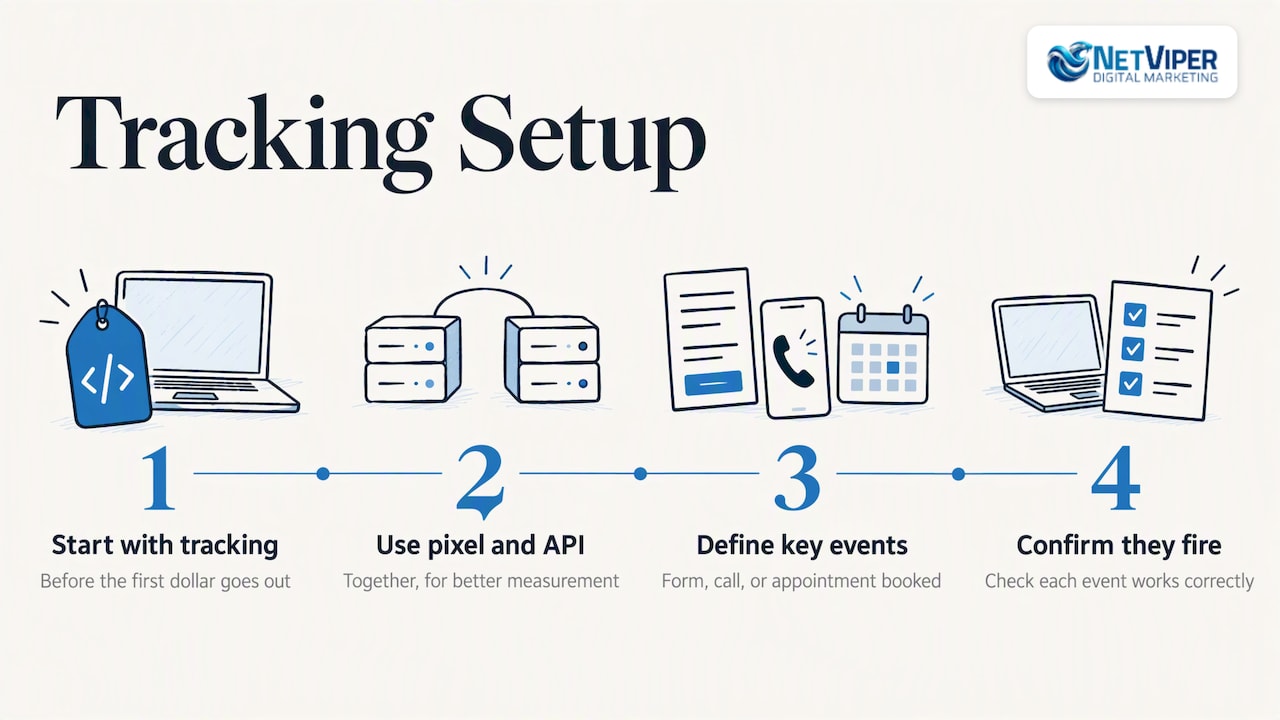
2. Tracking before spend
Tracking comes before the first dollar goes out. Meta says that if you share events using the pixel, it also recommends the Conversions API, which works with the pixel to improve measurement and campaign performance. In practice, that means defining the events that matter (form submitted, call clicked, appointment booked) and confirming they fire correctly.
3. Creative and landing page
An ad is only half the conversion. If the click lands on a slow or cluttered page, the budget leaks. Dedicated pages built for one offer usually outperform a home page. Our landing page guide covers what to put on them.
4. Launch with a test plan
A competent agency launches a few distinct angles (for example price, speed, trust and a seasonal offer) rather than one ad. It sets a budget large enough for the platform to learn, and a rule for when to stop an ad.
5. Optimization loop
Every week or two, the team reads the results, pauses weak ads, scales strong ones and sends new creative. Many strong accounts are won by creative volume and iteration, not clever settings.
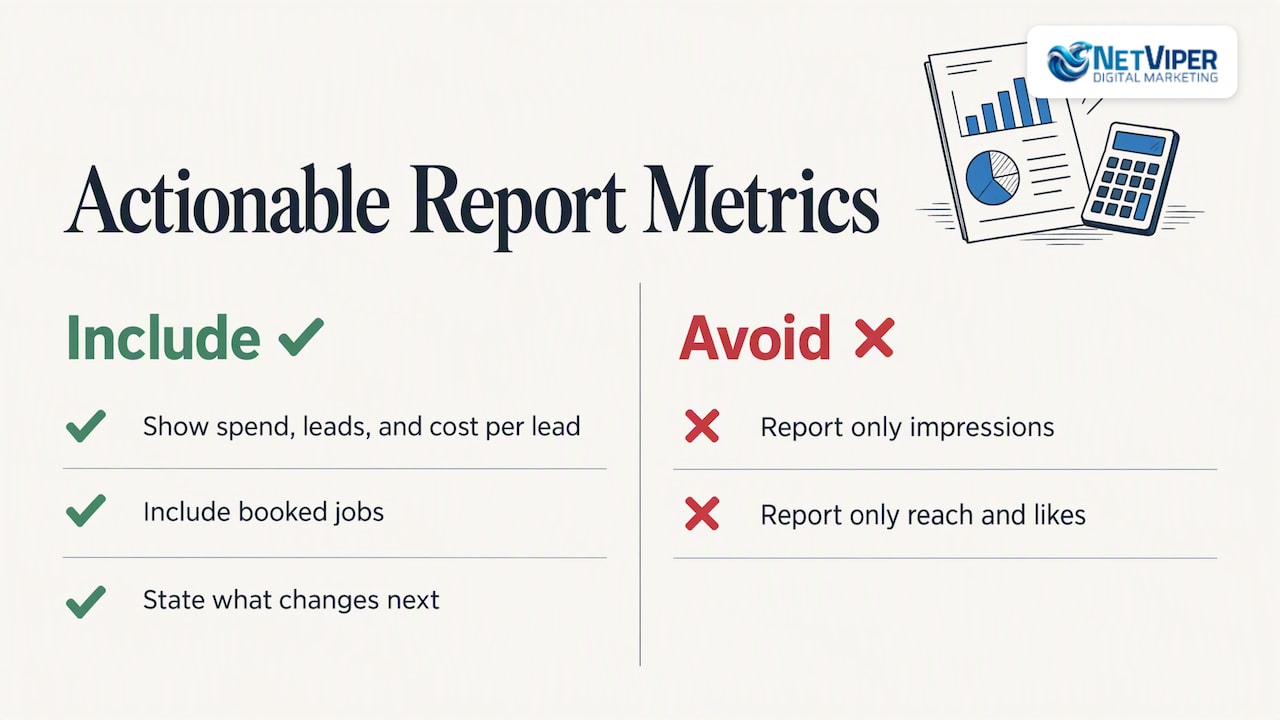
6. Reporting you can act on
Good reports show spend, leads, cost per lead, booked jobs and what changes next. Weak reports show impressions, reach and likes.
How to evaluate an agency before you sign
One practitioner framework suggests judging agencies across five layers: business fit, channel strategy, creative engine, measurement and operating system. We have turned those layers into questions a local owner can ask on a first call.
| What to check | Question to ask | Good answer |
|---|---|---|
| Business fit | Have you worked with businesses like mine, in my market? | Specific local examples and an honest view of what Meta can and cannot do for your category |
| Strategy | What will you test in the first 60 days? | A written plan with angles, audiences and success thresholds |
| Creative | Who produces the ads and how often do they refresh? | A named process and a regular refresh schedule |
| Measurement | Which events will you track and how do you verify them? | A list of events, with a test before launch |
| Account access | Who owns the ad account and pixel? | You do, with the agency as a partner |
| Reporting | What will I see each month? | Spend, leads, cost per lead and booked jobs |
| Contract | How do I leave? | Short notice, no lock on your assets |
Account ownership is not optional
Meta lets the owner of a business portfolio share ad accounts and Pages with an agency. Per Meta’s help center, you can give a partner full control or partial access to business assets, and only the organization that owns an asset can share it with another business portfolio. The practical rule: create or confirm your own business portfolio, then add the agency as a partner. If an agency insists on running your ads from its own account and keeping the history, you may lose your audiences, pixel data and creative learnings when you leave.
Red flags
- Guaranteed lead counts or sales numbers
- No access for you to the ad account
- Reports with no link to leads or revenue
- Long contracts with no performance review
- One “proven” ad for every industry
- No plan for what happens after the lead arrives
What Meta agency support costs, and what drives it
Two separate costs exist: the ad spend you pay to Meta, and the fee you pay the agency. Do not let anyone blur them.
Agency fees vary with:
- Scope. Ads only, or ads plus landing pages, tracking, SEO and follow-up automation.
- Number of campaigns and offers. Three service lines need more structure than one.
- Creative volume. More testing needs more fresh ads.
- Tracking complexity. Call tracking, CRM syncing and multi-step bookings take setup time.
- Ad budget. Larger budgets demand more monitoring.
We do not publish a fixed price for stand-alone Facebook ad management because scope differs from business to business. What we do publish is our bundled option: the Full Digital Program is $1,995 per month with a one-time set-up fee of $2,500, and it brings together ads, search visibility and lead capture. Other published items include Listings & Citations at $60 per month, a Conversion Tracking Audit at $175 per hour and Paid Ads Coaching at $225 per hour, for owners who want to keep running ads in-house with expert guidance. Current details are on our pricing page.
How to measure whether Meta ads are working
Platform dashboards report what Meta saw. Your business needs to report what you got. Track these in order of importance:
- Booked jobs or sales from ads. The number that pays the bills.
- Cost per qualified lead. Not every form fill is a customer.
- Cost per booked appointment. Reveals problems in follow-up.
- Lead response time. Slow replies kill good campaigns.
- Return on ad spend. Revenue divided by ad spend, once sales are matched to the source.
- Click-through and conversion rate. Diagnostic metrics that explain why the numbers above moved.
Ask every lead how they found you, and compare the answer against the dashboard. If the two never agree, the tracking needs work. That is exactly what a conversion tracking audit is for.
Where AI fits: lead follow-up after the click
Most local businesses lose leads in the gap between the ad and the first reply. A person fills out a form at 8 p.m., and the owner calls back the next afternoon after the prospect has contacted two competitors. AI tools close that gap.
- Chatbots answer common questions on the landing page and qualify visitors. See our overview of AI chatbots for customer service and lead generation.
- AI voice agents answer calls, capture details and book appointments around the clock. Our AI agents page lists the options.
- Automated follow-up sends text or email within seconds of a form submission.
What to verify before you turn any of it on: that the bot only states facts you approved (hours, service areas, pricing rules), that it hands off to a person for anything unusual, that callers know they are speaking with an automated assistant where required, and that lead data lands in a system you own. Test it yourself with ten realistic calls before it touches a real customer.
Our perspective: ads, local search and follow-up work together
We work with local businesses in Northeast Florida, and the same pattern repeats. Owners rarely fail on Meta because the platform does not work. They fail because the ad is one piece of a chain, and one link is weak: the tracking is wrong, the landing page is generic, or the lead waits a day for a callback.
So we do not treat Facebook and Instagram advertising as a standalone product. We set it up next to Google Ads for people already searching, local SEO and Google Maps visibility for people comparing nearby options, and AI lead response so nothing slips. Meta is strong for creating demand and reminding people who have already visited your site. Google is strong for capturing people who are ready now. A local business usually needs both, in proportion to its budget.
Our advice to any owner: start with tracking, insist on owning your accounts, and judge every agency, including us, by booked jobs and cost per customer.
— Dave Fogel
How NetViper Interactive can help
If you run a business in Jacksonville, St. Johns County or the surrounding area, our team manages Facebook and Instagram campaigns with the tracking, landing pages and follow-up automation described above. You get direct access to local specialists, not a ticket queue. Start with our Facebook Ads Manager service, or see how the pieces combine in our digital marketing services.
Ready to talk through your numbers? Book a call on our calendar and we will review your current ads, tracking and lead response with you.
A quick checklist before you hire
- Write down what one new customer is worth to you.
- Create your own business portfolio and confirm you own the ad account and pixel.
- Ask for the tracking plan in writing.
- Ask how many new ads the agency will produce each month.
- Decide who answers leads, and how fast.
- Agree on a monthly report format and a review date at 60 to 90 days.
FAQ
What is the difference between a Meta ads agency and a social media agency?
A social media agency usually focuses on organic posting, community and brand content. A Meta ads agency focuses on paid campaigns and measurable results such as leads and bookings. Some firms do both, but ask which one is their strength.
Should I let the agency set up the ad account?
The account should sit inside your own business portfolio, with the agency added as a partner. Meta allows this, and it keeps your pixel data and ad history yours if you ever switch providers. Avoid arrangements where you cannot log in and see spend.
How long before Meta ads produce results?
You can see leads within days of launch, but the first weeks are for testing. Plan on a 60 to 90 day window to judge the campaign properly, with tracking verified before spend begins. No honest agency can promise a specific outcome.
Do I need Meta ads if I already run Google Ads?
Often yes, because they reach different moments. Google captures people searching for your service now, while Meta reaches people who have not started searching yet and retargets past visitors. Budget and goals decide the split.
Can AI replace my staff for answering leads?
AI can answer instantly, qualify and book simple requests, which helps outside business hours. Complex or sensitive calls should still route to a person. Test the setup thoroughly before relying on it.
Sources
- Set up and install the Meta Pixel (Meta Business Help Center)
- Give a partner access to business assets in your business portfolio (Meta Business Help Center)
- Facebook Ads Agency: Do You Need One? (Victoria Alenich)
- Social Media Advertising Companies: A Practical Framework (Filip Konecny)
Recommended

Chatbot Development for Business: What It Involves and How to Start
Chatbot development for business explained: what a chatbot can do, how projects are built, what to plan for, and how local businesses get one live without the guesswork.
Google Ads Budget: How Much to Spend and How to Set It
Learn how a Google Ads daily budget works, how to calculate a monthly budget from your lead goals, and what a local business should spend to get real data.
Google Business Profile Optimization in Jacksonville, FL
How Jacksonville businesses optimize a Google Business Profile: the steps that move Maps rankings, what to measure, what it costs and when to hand it off.
