
A local SEO citation is any online mention of your business’s name, address and phone number (NAP), and the job is to make every mention match your Google Business Profile exactly. Get that right and Google can trust who you are and where you operate. Get it wrong and you leak calls, directions and map visibility. For a local business, the winning approach is to build the core set once, keep it consistent, and let someone own it month after month. That is the work our local listings management service is built around.
TL;DR
- A citation is a mention of your business’s name, address and phone number on another website, such as a directory, a chamber of commerce page or a social profile.
- Consistency matters more than volume: the same name, address, phone number and website everywhere.
- Build in order: Google Business Profile first, then major data and general directories, then industry and local sources.
- Citations support your map rankings but do not replace reviews, a strong Google Business Profile and a good website.
- Our Listings & Citations service is $60 per month, and our SEO packages fold citation work into a wider local ranking plan.
Table of Contents
- What local citations are
- Why citations still matter for local rankings
- The four details that must match everywhere
- Which citations you need
- How to build local citations step by step
- Common mistakes that cost you rankings
- Doing it yourself, or handing it off
- Local citation management with NetViper
- Our perspective on citations
- How citations fit with the rest of your local presence
- FAQ
- Sources
What local citations are
A citation is a reference to your business on a site you do not own. It usually includes your business name, address and phone number, and often your website, hours, category and a short description. It does not need a link to count. A mention on a directory, a local news site, a chamber of commerce member page or a social profile can all serve as one.
There are two kinds worth knowing:
- Structured citations appear in a defined listing format: business directories, review sites, maps and navigation apps, and industry directories. Each field (name, address, phone, category) has its own place.
- Unstructured citations are mentions inside other content: a newspaper article about your grand opening, a blog post about local contractors, a sponsor page for a youth league.
Most of your effort goes into structured citations, because they are the ones you can create and control. Unstructured ones come from being active in your community and from local PR.
Why citations still matter for local rankings
When someone searches “plumber near me” or “dentist in Jacksonville,” Google decides which businesses to show in the map results using relevance, distance and prominence. Citations feed that decision in two ways.
First, they confirm your facts. Google’s own guidance for businesses stresses representing your business accurately and as it exists in the real world, which you can read in Google’s guidelines for Business Profiles. When independent sites repeat the same details, you reinforce that picture. When they disagree, you introduce doubt.
Second, they put you where customers look. People find businesses through map apps, voice assistants, in-car navigation and review sites as well as Google. A wrong phone number on any of those is a lost call.
Citations are a foundation rather than a growth lever. They will not outrank a competitor with far more reviews and a better-optimized profile on their own. They keep you from being held back, and they make everything else you do in local SEO work harder.
The four details that must match everywhere
Every listing should carry the same four core details, character for character:
- Business name. Use your real, public-facing name. Do not add keywords (“Smith Plumbing | Best Plumber Jacksonville”), because that conflicts with Google’s representation rules.
- Address. Pick one format and keep it. “Suite 200” and “Ste. 200” and “#200” look different to a system matching records.
- Phone number. Use one primary local number. If you use call tracking numbers for ads, set them as secondary numbers where the platform allows it, so your main number stays the consistent one.
- Website URL. Point every listing to the same canonical address, with or without “www” and with https, the same way each time.
If you serve customers at their location and do not want your address shown, hide it everywhere that allows it, and do so consistently. A service-area business that shows an address on one directory and hides it on another creates the same confusion as a typo.
Which citations you need
Not every directory is worth your time. Think in layers.
Layer 1: Core platforms
Your Google Business Profile is the most important listing you have, so complete it first. Then claim the other major map and navigation platforms, Bing Places and Apple’s business listing tools, plus the main social profiles. Our Google Business Profile optimization work starts here because every other listing should copy this one.
Layer 2: General directories and data aggregators
These are the broad business directories and the data providers that feed many smaller sites. A correct listing at this level tends to spread outward on its own, and a wrong one spreads the error the same way.
Layer 3: Industry-specific directories
A roofer wants home-service and contractor directories. A dentist wants healthcare directories. An attorney wants legal directories. These matter because they tell Google what category you belong to and put you in front of people who are already looking for your kind of service.
Layer 4: Local sources
In Northeast Florida this means local chambers of commerce, business associations, neighborhood and community sites, local news outlets and sponsor pages for events you support. These are harder to get, which is part of why they carry weight. A Jacksonville business gains little from forty national directories and a lot from a handful of relevant local ones.
A useful rule: if a real customer could plausibly see the site, or if the site is a recognized source in your industry or city, list there. If it is an obscure directory that exists to sell ad placements, skip it.
How to build local citations step by step
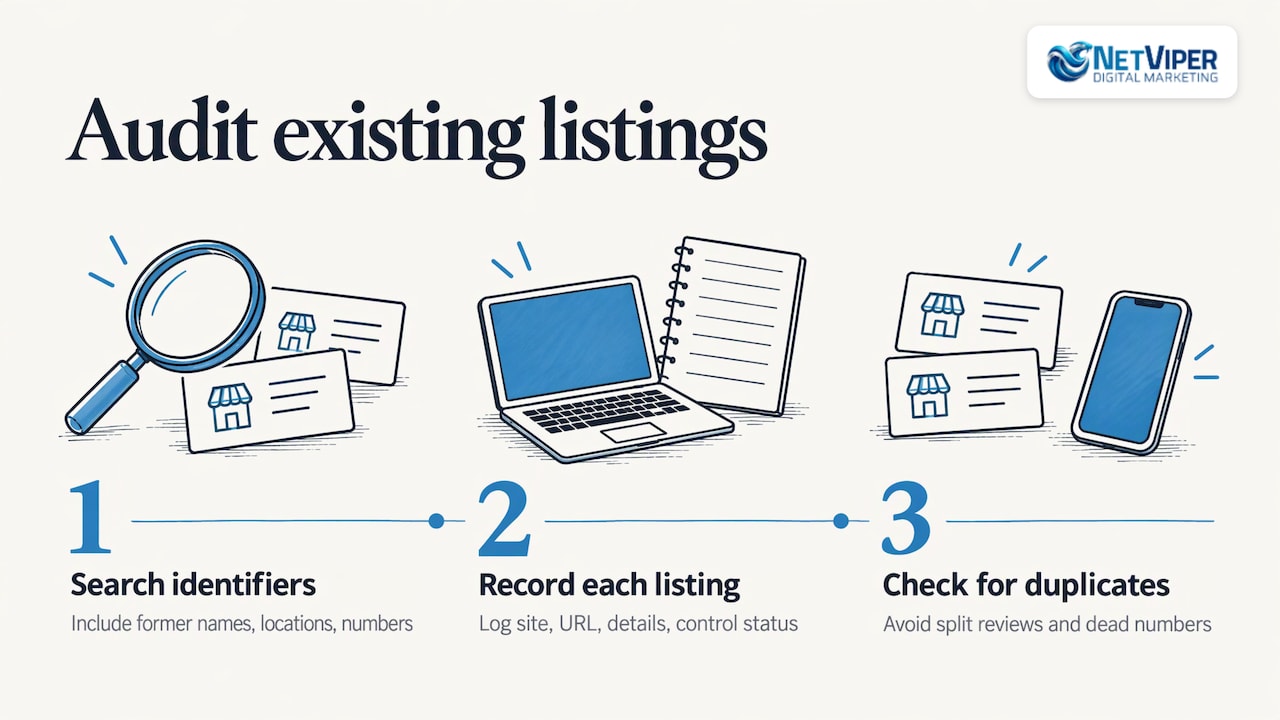
Step 1: Audit what already exists
Before you create anything, find what is out there. Search your business name, your phone number and your old addresses. Include former names, previous locations and numbers you no longer use. Record each listing in a spreadsheet with the site, the URL, what it shows and whether you control it.
This is where most owners hit trouble. Duplicate listings, often created by a previous owner, a former agency or an automated data feed, are common. Several listings for one location can split your reviews and send customers to dead numbers.
Step 2: Set your master record
Write down the exact name, address, phone, website, categories, hours and a short and long description you will use everywhere. Match it to your Google Business Profile. Every submission after this is copy and paste.
Step 3: Fix before you add
Claim and correct the existing listings first. Merge or remove duplicates through each platform’s process. Updating an old listing is almost always better than leaving it and creating a new one beside it.
Step 4: Build the core and industry listings
Work through layers 1 to 3. Fill in every field the platform offers: categories, services, hours, photos, a description and your website. A thin listing does less than a complete one.
Step 5: Add local citations
Join the chamber, sponsor the team, speak at the local event, offer a quote to the local paper. Each earns a mention that a directory submission cannot buy. Our own Jacksonville local marketing and local SEO approach treats these as part of the plan and not an afterthought.
Step 6: Track and maintain
Citations decay. You move, change a number, rebrand, add a location or change hours, and third-party sites keep the old version. Review your listings at least quarterly and after any change to your business details. Pair that with active reputation management, since many citation sources are also review sites.
Other business owners share their own experience of tying citation work into broader on-site and local content, for example in this walk-through of optimizing a service website for local searches.
Common mistakes that cost you rankings
- Inconsistent formatting. Abbreviations, suite numbers and old phone numbers create conflicting records.
- Keyword stuffing the name. It risks suspension of your Google listing and gains nothing.
- Creating duplicates. Always search before you submit.
- Chasing quantity. One hundred low-quality listings do less than twenty accurate ones in the right places.
- Forgetting changes. A move or a new phone number needs a full sweep, not just an update on your website.
- Ignoring the listing content. Categories, services and descriptions drive relevance. A name-and-number-only listing wastes the opportunity.
Doing it yourself, or handing it off
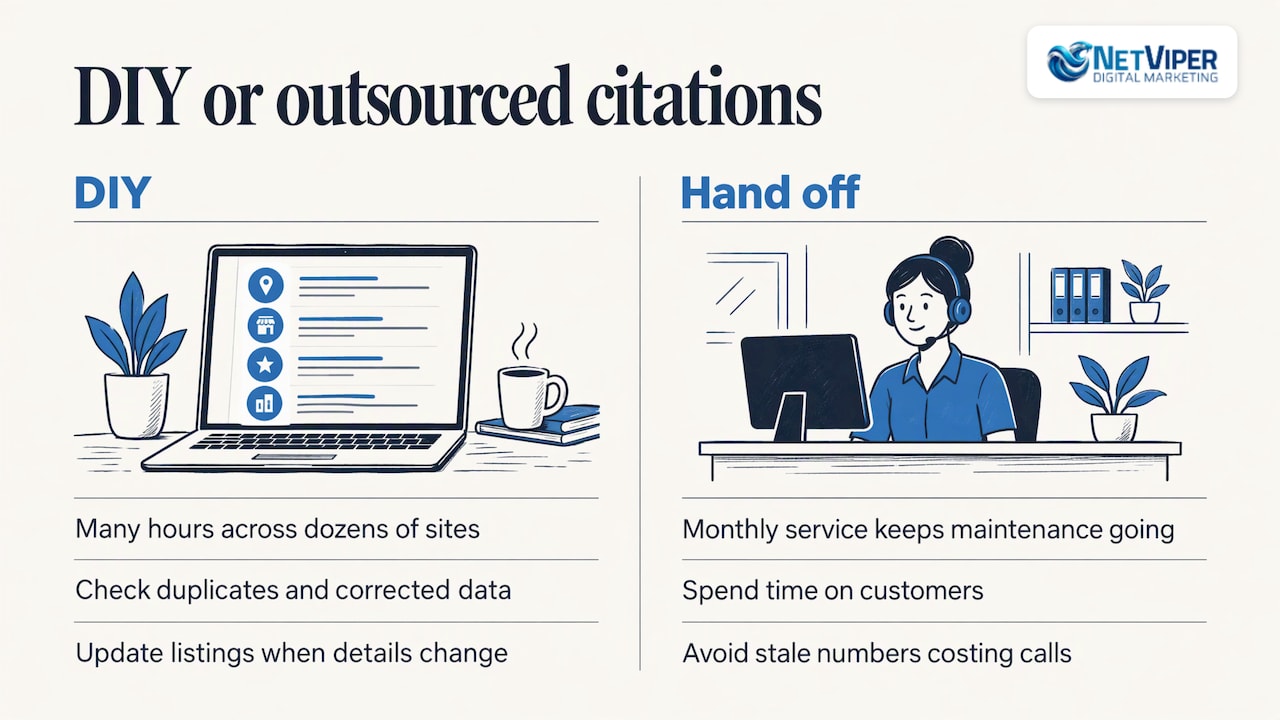
The work itself is not complicated, but it is time consuming. A thorough audit and first build can run many hours across dozens of sites, each with its own login, verification step and field limits. The ongoing part is the real cost: checking for new duplicates, correcting data that aggregators push back onto your listings, and updating everything when anything changes.
That is why most owners we work with prefer to hand the citation work to a team and spend their time on customers. A monthly service also means the maintenance is not forgotten six months in, when a stale number is quietly costing you calls.
Local citation management with NetViper
Our Listings & Citations service is $60 per month. It covers keeping your business listings accurate across the web, so your name, address and phone number match your Google Business Profile. You can see how it connects to the rest of our local work on our SEO services page.

If you want citations as part of a wider plan to climb the map pack, our GeoBoost 25 plan is $497 per month and GeoBoost 100 is $1,697 per month, and our SEO + Local SEO service is $1,495 per month. If you are not sure where your listings stand today, start with an SEO audit of your Jacksonville or St. Augustine business, or talk to us through our main site about which option fits.
Our perspective on citations
Most local business owners we meet think of citations as a one-time chore. They fill in a few directories, forget about them, and then wonder why the phone number on an old listing is still sending customers to a disconnected line.
We treat citations as infrastructure. They are not exciting, but a consistent set of listings is what lets the exciting work, Google Business Profile optimization, reviews, local landing pages and Google Ads, perform. That is why we pair listings with the rest of the local plan and why we lean on local expertise in Northeast Florida: the chamber pages, community sites and neighborhood sources that matter in Jacksonville and St. Augustine are not the same as the ones that matter elsewhere.
Our advice is to build the foundation once, keep it clean, and put your energy where customers actually decide: your profile, your reviews and the speed at which you respond to a new lead.
Dave Fogel
How citations fit with the rest of your local presence
Citations support three other parts of your marketing:
- Google Business Profile. The profile is the center. Citations confirm it.
- Your website. Put your NAP on every page footer and on a contact page, in the same format as your listings. A local landing page for each service area helps connect those listings to the pages you want to rank.
- Lead response. Better visibility means more calls and form fills. If no one answers quickly, the extra visibility is wasted, which is why we build automated lead follow-up alongside local SEO.
For a wider view of how these pieces turn visibility into customers, see our guide to local business lead generation.
FAQ
What are local citations?
Local citations are online mentions of your business’s name, address and phone number, usually on directories, maps, review sites and local organization pages. They help search engines confirm your business details and help customers find and contact you. A mention does not need a link to count.
How many citations does a local business need?
There is no magic number. Focus on the major platforms, the leading general directories, the directories for your industry and a few strong local sources. A small set of accurate, complete listings in the right places beats a long list of obscure ones.
Do citations still help with Google Maps rankings?
Yes, as a foundation. Consistent information supports trust in your business details, but reviews, a fully built Google Business Profile and your website also drive map results. Treat citations as the base that lets those other efforts work.
How much does citation management cost?
Our Listings & Citations service is $60 per month. Broader local SEO plans that include citation work start at $497 per month with GeoBoost 25. Pricing from other providers varies, so compare what each includes, such as audits, duplicate cleanup and ongoing monitoring.
How often should I update my citations?
Review them at least quarterly, and immediately after any change to your name, address, phone number, website or hours. Old data on third-party sites can resurface after you fix it, so ongoing monitoring is what keeps them accurate.
Sources
Recommended

Google Business Profile Optimization in Jacksonville, FL
How Jacksonville businesses optimize a Google Business Profile: the steps that move Maps rankings, what to measure, what it costs and when to hand it off.

Local SEO Citations: What They Are and How to Build Them
Local SEO citations explained for business owners: what they are, which ones matter, how to build and keep them consistent, and what citation management costs.

Facebook Ads Budget: How Much to Spend and How to Set It
Set your Facebook ads budget with a simple formula: daily vs lifetime budgets, how Meta spends your money, and what a local business should plan to spend.
