
The right Facebook ads budget is not a fixed number. It is your target cost per result multiplied by the results Meta needs to optimize delivery, spread across a week. For a local business, that means working backward from what a lead or booking is worth, then choosing a daily budget that can actually produce enough results to learn from. This guide shows the formula, the Meta rules that decide how your money is spent, and how to adjust once data comes in.
TL;DR
- Start with your target cost per lead or booking, multiply it by 50, then divide by 7. That is the daily budget at which an ad set can usually exit the learning phase.
- A daily budget is an average. Meta can spend up to 75% more on a strong day, but never more than 7 times your daily budget in a week.
- Use a daily budget for ongoing campaigns and a lifetime budget when you have a fixed end date and a hard total.
- Spreading a small budget across many ad sets starves each one of data. Fewer, better-funded ad sets learn faster.
- Track calls and form fills before you raise spend, so every dollar is measured against real leads.
Table of Contents
- Start with the result you need, not the dollar amount
- Daily budget vs. lifetime budget
- Campaign budget or ad set budget
- The formula: target cost per result × 50 ÷ 7
- Minimums and bid rules that can trip you up
- A starting budget by business type
- How to set the budget in Ads Manager
- Optimizing the budget as results come in
- Where a managed approach pays for itself
- Our perspective on Facebook ad budgets
- FAQ
- Sources
Start with the result you need, not the dollar amount
Most owners ask “how much should I spend?” before they know what a customer is worth. Reverse the question. If a new customer is worth $600 in profit and one in five leads becomes a customer, you can afford to pay up to $120 per lead and still come out ahead. Your budget is whatever it takes to buy the number of leads you want at a cost per lead you can live with.
That is why generic answers such as “$10 a day” or “$1,000 a month” are only starting points. A dentist, a roofer and a boutique fitness studio in Jacksonville have very different lead values, and so very different budgets that make sense. Before you open Ads Manager, write down three numbers:
- What a customer is worth to you in gross profit.
- The share of leads that turn into customers.
- The most you can pay per lead and still profit.
The third number is your target cost per result. Everything below builds on it.
Daily budget vs. lifetime budget
Meta gives you two ways to set what you spend.
Daily budget. You tell Meta the average amount you want to spend per day. Meta says daily budgets are not a hard cap: it may spend more on days with better opportunities and less on others, and in any week it will not spend more than 7 times your daily budget. A $50 daily budget can never cost more than $350 in a Sunday-to-Saturday week.
Lifetime budget. You set a total for the campaign’s start and end dates, and Meta paces it across that window. Meta’s lifetime budget page explains how it works. It suits a promotion with a fixed end, such as a grand opening, a seasonal offer or an event, where you must not exceed a set amount.
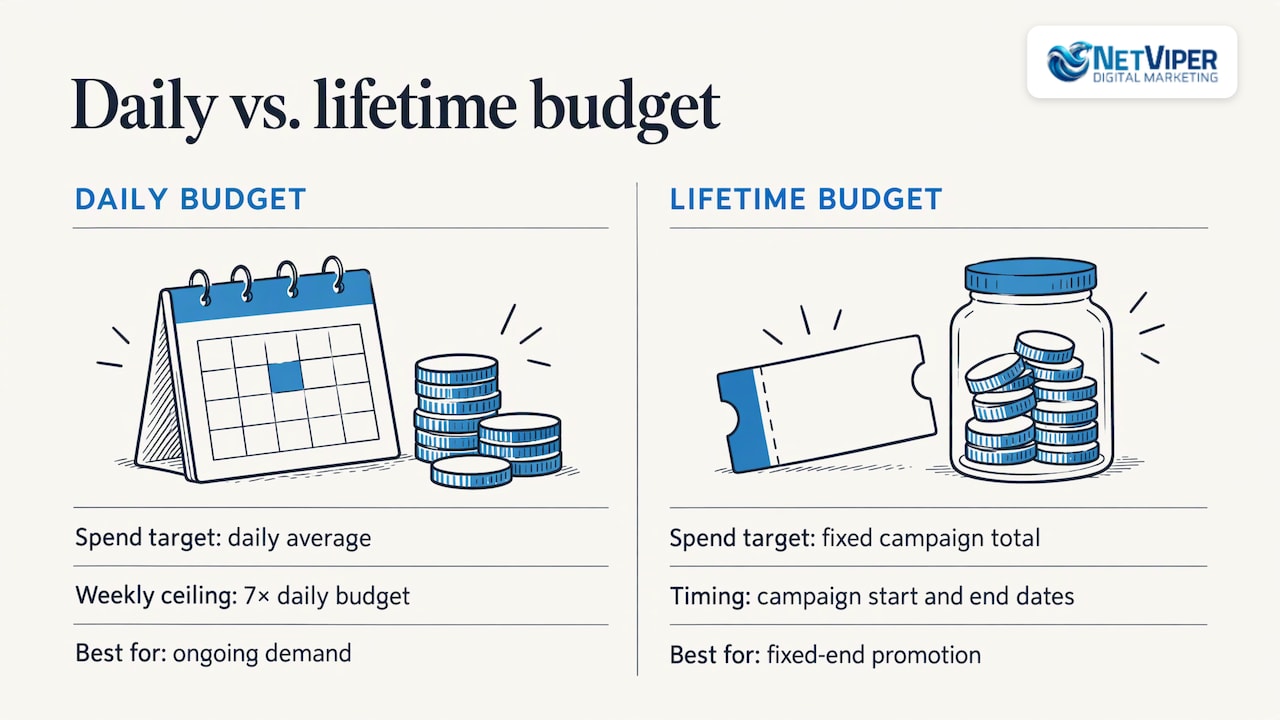
For most local service businesses with ongoing demand, a daily budget is the practical choice because you can raise or lower it as results change.
How much more than your daily budget can Meta spend?
After an update in 2025, Meta announced that it may spend up to 75% over the daily budget on high-opportunity days, up from 25%, while the weekly total stays within 7 times the daily figure. On a $40 daily budget, one strong day could reach $70, and the following days will run lower so the week balances out. Plan your monthly cash around the average, but do not be surprised by an uneven daily line in your reports.
Campaign budget or ad set budget
Inside Ads Manager you also choose where the budget lives:
- Campaign budget: one budget for the whole campaign. Meta distributes it across ad sets (the groups that hold your audience, placements and schedule) toward the ones getting results. Judge performance at the campaign level, because spend will not split evenly.
- Ad set budget: each ad set gets its own budget, which gives you control over how much each audience receives.
For a small local account, the simpler setup is usually better: one campaign, one or two ad sets and a few ads. A tight structure puts all your spend behind fewer decisions, which is exactly what a modest budget needs.
The formula: target cost per result × 50 ÷ 7
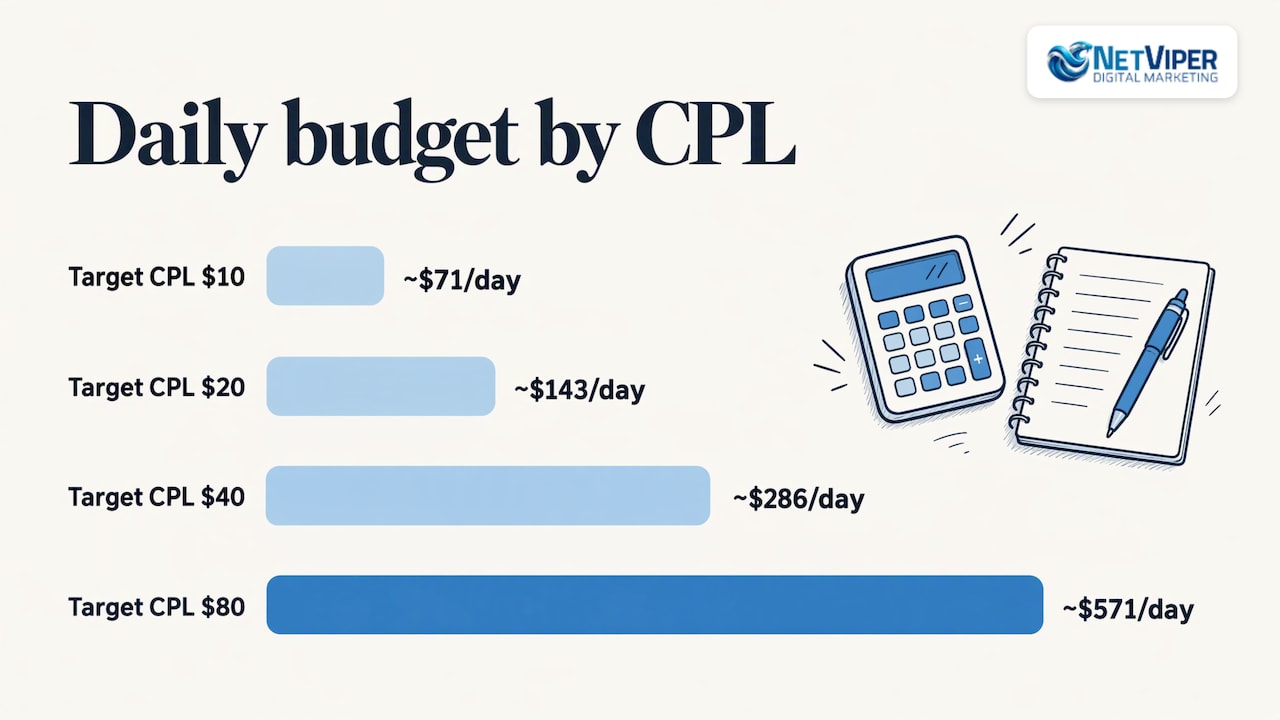
Meta’s delivery system needs data to find the people most likely to act. Shopify’s cost guide describes the learning phase as lasting until an ad set collects roughly 50 results in the week after its last significant edit, and gives the budgeting formula that follows from it: multiply your expected cost per result by 50, then divide by 7 to get a daily budget.
Here is the math with illustrative numbers:
| Target cost per lead | Leads needed per week | Weekly budget | Daily budget |
|---|---|---|---|
| $10 | 50 | $500 | about $71 |
| $20 | 50 | $1,000 | about $143 |
| $40 | 50 | $2,000 | about $286 |
| $80 | 50 | $4,000 | about $571 |
These are calculations from the formula, not predictions of what your leads will cost. Your real cost per lead depends on your industry, offer, creative, landing page and market.
What if the formula gives a number you cannot afford?
This is the common situation for local businesses. A $40 lead target points to roughly $286 a day, which is $8,600 or so in a month. There are three honest ways to respond:
- Optimize for a result that happens more often. A click on a call button or a form start costs less than a booked job, so the same money produces more events for Meta to learn from. You then qualify leads on the back end.
- Narrow the structure. One ad set with one audience gets the whole budget. Splitting $30 a day across four ad sets gives each less than $8.
- Decide what the budget is for. A smaller budget can test your offer, creative and landing page. A larger one can scale a proven campaign. Mixing the two goals is how money gets wasted.
If you are testing, give the test enough time and money to answer a question. Plan for several weeks, not a few days, and define in advance what result would make you increase spend.
Minimums and bid rules that can trip you up
If you use a cost per result goal as your bid strategy, Meta’s guidance on minimum budgets says the daily budget should be at least 5 times your cost per result goal. A $10 goal needs at least a $50 daily budget. Setting a goal that your budget cannot support limits delivery, and the campaign may barely spend.
If Ads Manager shows a message that your budget is too low, Meta’s budget is too low page explains the fix. When you change a budget on a live campaign, Meta’s change your budget page covers the steps. Because significant edits can restart learning, make changes deliberately rather than every day.
A starting budget by business type
Use the formula to set a range, then place yourself on it:
- Lead-based local services (home services, dental, legal, med spa): calculate from your cost per lead. If your target is $40, the formula shows what full learning costs, and any budget below that is a controlled test.
- Appointment or event promotions: a lifetime budget with a defined end date keeps the total fixed.
- Retail or restaurant traffic campaigns: cost per result is lower, so the formula gives a smaller daily figure, but you still need a way to measure visits or redemptions.
The question “is $300 or $500 enough?” has a simple answer in this framework. It is enough to learn something if you hold it to a narrow job: test one offer, one audience and two or three ads, with call and form tracking in place. It is not enough to fully fund the learning phase when your cost per lead is $40 or more. Decide which job you are buying before you spend.
How to set the budget in Ads Manager
- Pick the objective that matches the result you want, such as leads or calls, not just traffic.
- Choose campaign budget or ad set budget. For one or two ad sets, either works; keep the structure simple.
- Choose daily or lifetime. Daily for ongoing campaigns, lifetime for fixed-date promotions.
- Enter the figure from your formula, or your test budget if you are validating an offer first.
- Set your location tightly. A Jacksonville plumber paying to reach the entire state is spending on people who cannot buy. See our guide to local Facebook advertising for how to reach nearby customers.
- Install tracking before launch. Without it you only see clicks, not leads.
Step six is where many local campaigns go wrong. Clicks are cheap to count and easy to misread. Phone calls, form submissions and bookings are what pay the bills. Our guide to call tracking for ads shows how to measure every call your ad spend earns. If you want a second pair of eyes on your setup, our Conversion Tracking Audit is listed at $175 per hour.
Optimizing the budget as results come in
Once data arrives, the work shifts from setting the budget to directing it.
- Judge by cost per lead, not impressions or clicks. Twelve leads at a known cost tell you more than thousands of impressions.
- Give changes time. Each significant edit can send an ad set back into learning, so evaluate over several days rather than reacting to a single bad afternoon.
- Raise spend in steps. When a campaign hits your target cost per lead, increase the budget gradually instead of doubling it overnight, so delivery stays stable.
- Cut waste first. An ad set that has spent several times your target cost per lead without a result deserves a pause or a new creative before it gets more money.
- Consolidate. If you have several ad sets each starved of data, merge them. Budget and structure are one decision, not two.
The landing page matters as much as the budget. If your page converts 4% of visitors instead of 2%, the same ad spend produces twice the leads and your cost per lead drops by half. Our landing page optimization work is built for exactly that.
Where a managed approach pays for itself
A budget is only as good as the system it feeds. Setting audiences, writing ads, tracking calls, fixing the landing page and reading the results is a weekly job, and every week the account runs unmanaged, spend can leak. That is the reason local owners hand the job to a specialist team.
Our Facebook Ads Manager service is built for local businesses in Northeast Florida. We pair campaign management with conversion tracking and landing pages so that your budget is measured against leads, not clicks. If you also want paid search and SEO working alongside Facebook, our Full Digital Program is $1,995 per month with a one-time set-up fee of $2,500. If you would rather learn to run the account yourself, our Paid Ads Coaching is $225 per hour. Details are on our all services page.
If you are still weighing whether paid social fits your business, read are Facebook ads worth it first, then come back to your numbers.
Our perspective on Facebook ad budgets
Most budget problems we talk about with local owners are not about the amount. They are about what the money is asked to do. A business that expects a $300 budget to behave like a $3,000 budget will be disappointed, and a business that spreads $3,000 over six audiences will get the same result as one that spent $500.
The approach we favor is to decide the target cost per lead first, fund fewer ad sets properly, measure every call and form, and send the traffic to a page built to convert. When those pieces are in place, increasing the budget is a decision backed by data instead of hope.
Local context matters too. Northeast Florida customers search, scroll and book differently from a national audience, and a campaign aimed at your service area, with an offer that fits it, gives each dollar a better chance to reach someone who can actually buy.
Dave Fogel
FAQ
Is $300 enough for Facebook ads?
It is enough to run a focused test, not to fully fund the learning phase for most lead-based businesses. Use it for one offer, one tightly targeted audience and a few ads, with call and form tracking from day one. Run the formula above to see how far it sits from a fully funded campaign.
Is $500 enough for Facebook ads?
It can fund a meaningful test of creative, audience and landing page, especially when kept in one campaign with one or two ad sets. At a target cost per lead of $40, a fully funded ad set needs about $2,000 per week by the formula, so treat $500 as a learning budget and decide in advance what result would justify raising it.
Should I use a daily or a lifetime budget?
Choose a daily budget for ongoing lead generation, because you can adjust it as results change. Choose a lifetime budget for a promotion with a fixed end date and a total you must not exceed. In both cases, Meta’s daily budget rules mean daily spend can vary, while weekly spend stays within 7 times the daily figure.
Why did Facebook spend more than my daily budget?
A daily budget is an average. Meta may spend up to 75% more on a day with strong opportunities and spend less on others, and it keeps the weekly total at or below 7 times the daily amount. Your weekly spend still lines up with the budget you set.
How often should I change my budget?
Change it deliberately, not daily. Significant edits can restart the learning phase, so give the campaign several days of data, raise spend in moderate steps when you are hitting your target cost per lead, and reduce or restructure when an ad set spends without producing results.
Sources
- About Daily Budgets, Meta Business Help Center
- About lifetime budgets, Meta Business Help Center
- Best practices for minimum budgets, Meta Business Help Center
- Budget is too low, Meta Business Help Center
- Change your budget, Meta Business Help Center
- Meta outlines latest updates to its marketing and Graph API, Social Media Today
- How much do Facebook ads cost? Shopify
Recommended

Facebook Ads Budget: How Much to Spend and How to Set It
Set your Facebook ads budget with a simple formula: daily vs lifetime budgets, how Meta spends your money, and what a local business should plan to spend.

Jacksonville Small Business Website Design: What Your Site Needs
What a Jacksonville small business website needs to win local searches, Google Maps visibility and ad leads, and how to judge whether your site is working.

Landing Page Conversion Rate: What’s Good and How to Raise It
Learn how to calculate your landing page conversion rate, what benchmarks to expect, and which changes lift lead conversions for a local business.
