
Google Ads management in Jacksonville is priced in two separate parts: the fee you pay a manager, and the ad spend you pay Google. Most confusion about cost comes from mixing them up. The management fee depends on the pricing model and the work behind it. The ad spend depends on your market and your budget. The best value comes from a Jacksonville team that builds both around the leads your business actually needs, which is how we approach it at NetViper Interactive.
This guide explains how each part is calculated, what a fair fee should cover, and how to judge whether the money is working.
TL;DR
- Two costs apply: a management fee to your agency or specialist, and ad spend paid directly to Google. Only the second one buys clicks.
- Google has no flat fee or subscription. You set your own budget and pay by clicks, impressions or another campaign pricing method.
- Management fees usually take the form of a flat monthly retainer, a percentage of ad spend, a hybrid of the two, or an hourly rate. Setup fees are common.
- Judge cost by cost per lead and cost per customer, not by the size of the fee. That requires conversion tracking from day one.
Table of Contents
- The two costs: management fee and ad spend
- Common pricing models for management
- What a management fee should include
- What drives the ad spend side in Jacksonville
- Working out whether the cost is worth it
- Why leads are lost after the click
- When Google Ads and local SEO work together
- Our perspective
- Getting started with NetViper
- FAQ
- Sources
The two costs: management fee and ad spend
When a Jacksonville plumber, dentist or law firm asks what Google Ads costs, the honest answer has two numbers.
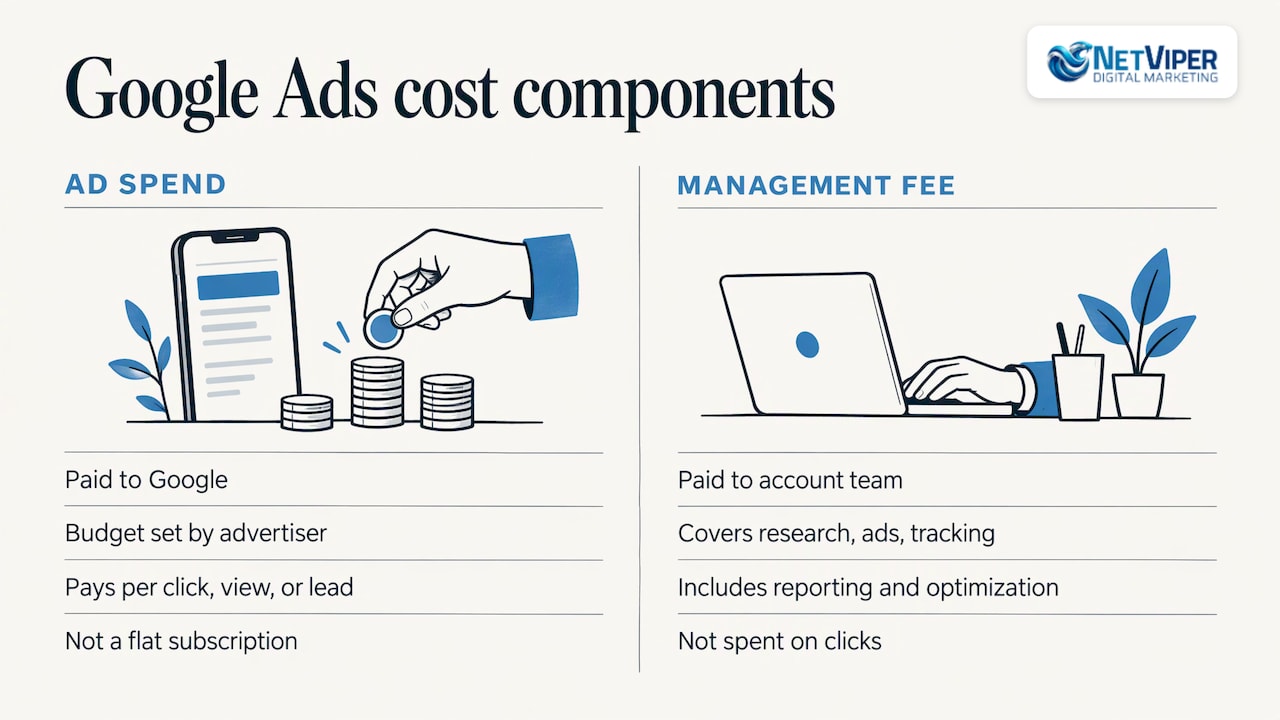
Ad spend goes to Google. Google says its platform has no flat fee or subscription: you decide your budget and pay according to the campaign’s pricing method. Search and Shopping campaigns are commonly priced per click, Display per thousand impressions, Local Services Ads per lead, and YouTube per view. For most local service businesses, Search campaigns priced per click are the core.
Management fee goes to the person or team who builds and runs the account. It pays for keyword research, ad writing, bid and budget control, tracking, reporting and ongoing optimization. It is not spent on clicks.
This split matters when you compare quotes. One provider may quote a low fee but add a percentage of your spend. Another may quote a higher flat fee and take nothing from your budget. A fee that looks cheap can cost more once your spend grows, and a fee that looks high can be fair if it covers setup, tracking and landing pages.
Common pricing models for management
Google Ads management is generally sold in four ways. Each suits a different situation.
| Model | How it works | Fits best |
|---|---|---|
| Flat monthly retainer | A fixed fee each month regardless of spend | Stable budgets, predictable planning |
| Percentage of ad spend | The fee rises and falls with your budget | Budgets that scale up and down |
| Hybrid | A base fee plus a smaller percentage of spend | Growing accounts with expanding workload |
| Hourly or project | Billed per hour or per task | Audits, tracking fixes, coaching |
Many providers also charge a one-time setup fee to cover the initial account build, keyword research and tracking installation. Ask for it to be itemized so you know whether you are paying for real build work.
How to compare quotes fairly
Put every quote on the same footing by working out the total monthly cost at your intended ad spend. Then add any setup fee spread over the first six to twelve months.
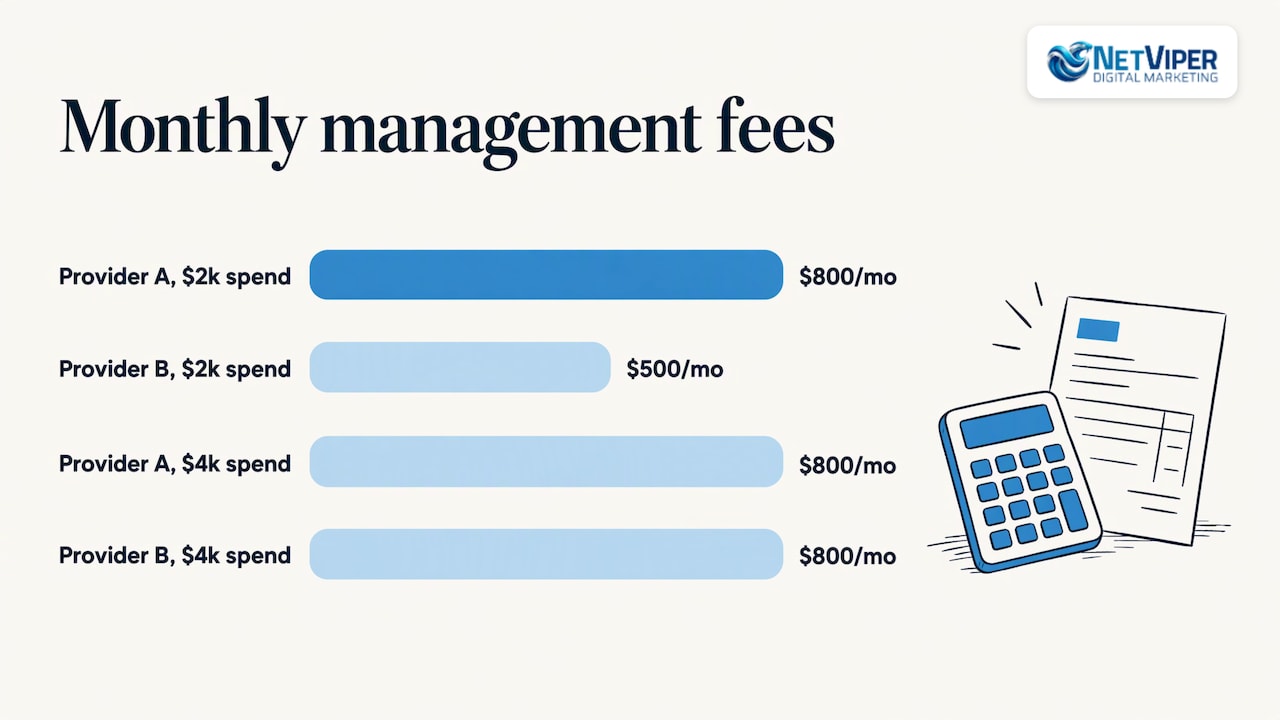
Here is a simple illustration with made-up numbers, not a quote. Say your monthly ad spend is $2,000. Provider A charges a flat $800 a month. Provider B charges 20% of spend with a $500 minimum, which is $500 at this spend level but would be $800 if you raised spend to $4,000. At $2,000 the two models cost the same on paper only if the percentage lands on $800 or more. The point is that the cheaper option today can reverse when your budget changes. Always run the numbers at your current spend and at the spend you hope to reach.
Also check the term. Some agreements run month to month, others require several months. A longer term is not a problem when it comes with a clear plan, but you should know the exit terms before you sign.
What a management fee should include
A fee is only fair if you know the work behind it. For a Jacksonville local service business, a complete management fee covers:
- Account structure and keyword research. Campaigns built around the services you want most, with the search terms that signal buying intent.
- Location targeting. Jacksonville is a large, spread-out city. Targeting by neighborhood, beach community or service area keeps spend near the customers you can serve. Google lists location targeting among the choices that influence what you pay.
- Ad copy and extensions. Messages that match what people search and give them a reason to call.
- Negative keyword management. Blocking irrelevant searches so the budget goes to people who might hire you.
- Conversion tracking. Counting calls, form fills and bookings so that cost per lead is a real number. See our guide to Google Ads conversion tracking and call tracking for ads.
- Landing pages. A page built for one offer converts better than a home page. We cover this in our landing page guide.
- Reporting. Plain-language reports on spend, leads and cost per lead, with next steps.
If a quote does not mention tracking, you will have difficulty ever judging whether the fee was worth paying.
What drives the ad spend side in Jacksonville
Your management fee is only half the picture. The ad spend you need depends on how competitive your category is. Google explains that auction cost and placement depend on bids, ad quality and relevance, assets, competition, seasonality and targeting choices, including location.
In practice, for Jacksonville that means:
- Category competition. Services where one job is worth thousands of dollars, such as roofing, legal, HVAC or medical, attract more bidders and usually higher clicks costs than lower-ticket services.
- Seasonality. Demand for air conditioning repair, hurricane-related services or beach-area tourism moves through the year, and so does competition for those searches.
- Ad quality. Relevant ads sent to a matching landing page can earn better placement for the money than generic ads sent to a home page.
- Geography. Narrowing to the areas you actually serve, from Riverside and San Marco to the Beaches and Mandarin, avoids paying for clicks you cannot convert.
There is no honest universal number for Jacksonville. Anyone quoting one without knowing your service, margins and service area is guessing. Our guide to setting a Google Ads budget walks through how to size spend to the number of customers you want.
How daily budgets work
One detail that surprises new advertisers: Google says your average daily budget may be exceeded by up to two times on a given day, while spending will not exceed the campaign’s monthly spending limit. So a $50 daily budget does not mean every day is exactly $50, but a month will not run past the cap. Plan your monthly number first and let a manager set daily budgets that fit it.
Working out whether the cost is worth it
The total you pay matters less than what each lead and customer costs you. Use this sequence.
- Know your customer value. What is a new customer worth in profit over the first year? A $3,000 job and a $150 service call justify very different costs.
- Set a target cost per customer. If an average customer brings $1,200 in profit and you are willing to spend a third of that to win one, your ceiling is $400 per customer.
- Estimate your close rate. If you close one in four leads, your ceiling per lead is $100.
- Count every lead. Calls, forms, chats and booked appointments all need tracking. After-hours and missed calls are lost leads you paid for.
- Divide total cost by customers won. Add the management fee and the ad spend, then divide by new customers from ads. That is your real cost per customer.
Tracking is where most accounts fall short. If you suspect your numbers are unreliable, our Conversion Tracking Audit is $175 per hour, and if your account is running but not producing, see Google Ads not converting.
Why leads are lost after the click
A fee that buys clicks does not buy customers. The money is made or lost in what happens next: how fast someone answers, and whether the page invites action.
Many local businesses pay for a click, then miss the call because the team is on a job or the office is closed. We built AI tools for this gap: chatbots and voice agents so a lead is responded to straight away. Our NV AI Pro Agent is $497 per month, with an AI Receptionist setup and deployment fee of $997 one-off, both on our AI agents page. Pair that with a page built to book appointments, such as a Smart Website, and the same ad spend produces more customers.
When Google Ads and local SEO work together
Paid ads and Google Maps rankings often serve the same customer at different moments. Ads appear the moment you switch them on and stop when you stop paying. Local SEO builds visibility that continues. Businesses that want both can look at our SEO plans: GeoBoost 25 is $497 per month and GeoBoost 100 is $1,697 per month, and Listings & Citations is $60 per month, all described on our SEO page. You can read how Maps results are decided in our guide to local search ranking factors.
Our perspective
Most Jacksonville owners we talk to ask the same first question: what does the management cost? We think the better question is what a lead costs, and whether anyone is answering it when it arrives.
That is why we treat Google Ads as one part of a lead system. The campaign has to be built around buying-intent searches in the neighborhoods you serve. The tracking has to count every call and form. The landing page has to make the next step obvious. And the response has to be instant, which is where our AI chatbots and voice agents come in.
Our specialists are certified in Google Ads and conversion optimization, and you work directly with local professionals who know Northeast Florida. We also lock local SEO territory, so the visibility you build in your area is not handed to a competitor next door.
A management fee is worth paying when it comes with that whole chain, because the click is only the start.
Dave Fogel
Getting started with NetViper
If you want Google Ads run by a team that works with Northeast Florida businesses every day, start with our Google Ads management service in Jacksonville. We do not publish a price for Google Ads management, because the right scope depends on your service, area and goals. For businesses that want ads, SEO and lead capture working together, our Full Digital Program is $1,995 per month with a one-time set-up fee of $2,500, listed on our all services page. For a broader look at what an agency does, see our Google Ads agency guide.
If you already run your own campaigns and want a sharper plan, Paid Ads Coaching is $225 per hour. Neighborhood pages are available for Riverside, San Marco, the Beaches, Mandarin, Downtown and Ponte Vedra Beach.
FAQ
Is the management fee included in what I pay Google?
No. Google charges only for ad spend, based on the campaign’s pricing method such as clicks or impressions, and it has no flat fee or subscription. The management fee is paid separately to your agency or specialist for building and optimizing the account.
Do I pay a setup fee?
Many providers charge a one-time setup fee for the initial build, keyword research and tracking installation. Ask for it to be itemized and confirm that tracking is part of it. Our own set-up fee for the Full Digital Program is $2,500 one-off.
How much should a Jacksonville small business spend on ads?
It depends on your category, service area and what a customer is worth. Work backward from your target cost per customer and your close rate, then size spend to the number of leads you need. Our Google Ads budget guide shows the calculation.
How soon can I tell if it is working?
With conversion tracking in place, you see calls and form fills from the first week of traffic. Judge results on cost per lead and cost per customer over a period long enough to gather meaningful data, and review them with your manager each month.
Sources
Recommended

Google Ads Management Cost in Jacksonville, FL
What Google Ads management costs in Jacksonville: how fees differ from ad spend, common pricing models, what a fee should include and how to judge the return.

CRM Lead Management: A Practical Guide for Local Businesses
How CRM lead management works for a local business: capture, qualify, route and follow up on leads, what to automate, and which numbers to track.

AI Call Answering Service: What It Does, Costs and Needs
How an AI call answering service works for a local business: what it handles, what it costs, how to set it up, and the Florida recording rules to know.
