
Multi-location SEO services make each of your locations or service areas visible to the people searching nearby, in Google Maps and in organic results. Done well, every location gets its own page, its own accurate Google Business Profile, consistent listings and its own reporting. Done badly, you get duplicate pages, conflicting phone numbers and a strong brand total that hides weak branches. For a Northeast Florida business with two, five or twenty locations, the case for a local agency is simple: the work is repetitive, detail-heavy and has to stay consistent month after month, and that is what a retained team is built to carry.
TL;DR
- Multi-location SEO adds a geographic layer: each real location needs its own page, Google Business Profile, local keywords, reviews, listings and tracking.
- Pages must carry real local substance. Swapping a city name on a template is a doorway page, not a location page.
- Service-area businesses follow different Google rules: up to 20 service areas, no radius, and a boundary of about two hours’ driving time.
- Measure by location, not in total. A healthy overall number can hide declining branches.
- Our published SEO plans run from $497 to $1,697 per month, so you can match scope to the number of locations you operate.
Table of Contents
- What multi-location SEO services actually cover
- Location pages: where most multi-location sites go wrong
- Google Business Profiles for every location
- Service-area businesses: the rules are different
- Listings, citations and reviews across locations
- Measuring results location by location
- What multi-location SEO services cost
- Where our local team fits
- Get a plan built around your locations
- FAQ
- Sources
What multi-location SEO services actually cover
Semrush defines multi-location SEO as improving local search visibility for a business that operates across more than one market: chains, offices, stores, clinics, service-area businesses and franchises. The key idea is the geographic layer. Each location may need its own page, Google Business Profile, local keywords, reviews, listings and tracking.
The reason is how Google ranks local results. According to Search Engine Land’s multi-location SEO guide, Google substantially personalizes results when a searcher wants something nearby, so every branch faces a different radius and different competitors. Your Jacksonville office and your St. Augustine office are not competing in the same market, even though they share a brand.
A complete engagement therefore usually includes:
- A location map. A list of every real location, service area and city you want to reach, so the website structure matches the business.
- Location pages. One page per real location with its own content.
- Google Business Profile management. Setup, cleanup and ongoing optimization per location.
- Listings and citations. The same name, address and phone number (NAP) across directories, so no location has a conflicting record.
- Review and reputation workflows. Requests and responses handled per location.
- Location-level reporting. Rankings, calls, direction requests and leads for each branch.
If you are earlier in the process and want the fundamentals first, our guide to local search ranking factors covers what moves a single location up.
Location pages: where most multi-location sites go wrong
Before anyone writes a page, the structure has to reflect reality. Search Engine Land’s article on structuring geographic pages advises separating four things: physical locations, regional markets, service areas, and cities the brand merely wants to rank in. It also notes that adding a city to a Business Profile service area does not require a landing page, and that publishing a page does not create a physical presence.
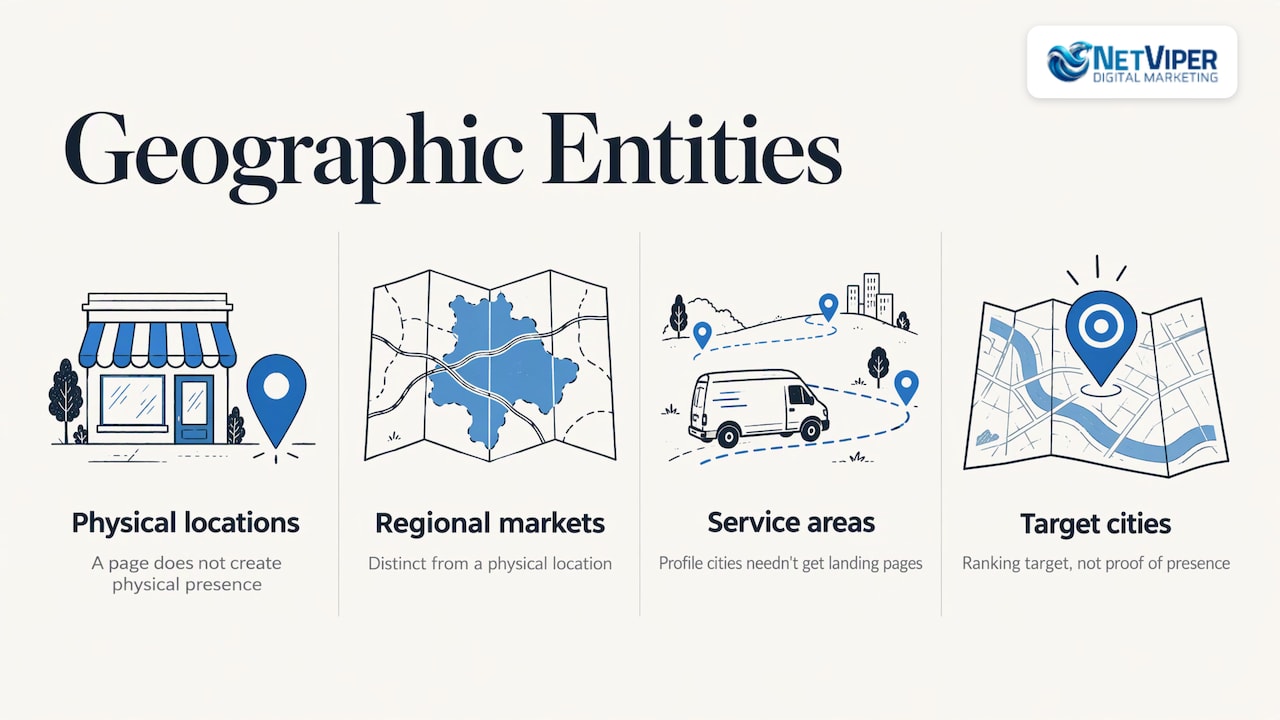
The practical result is a hub-and-spoke site: a main services hub, with a page for each real location linked clearly from it.
What a strong location page contains
Semrush recommends that every real location page include the address, phone, hours, services, staff, directions, photos, reviews and a clear way to call or book. Add details only that branch can offer: parking, neighborhoods served, local FAQs. Its rule of thumb is worth using as a test: if you could swap the city name and the page would still read as true, it lacks local substance.
Search Engine Journal’s guide to local SEO for multiple locations adds that each page should show photos of the actual storefront, interior and local team instead of generic stock images, along with reviews from customers who visited that branch.
Location, service-area and doorway pages
These are three different things, and mixing them up is the most common cause of thin content.
| Page type | What it is | When to build it |
|---|---|---|
| Location page | A real branch with its own address, hours and staff | Always, for every real location |
| Service-area page | A market you serve without a storefront there | Only with real search demand, real coverage and enough local substance |
| Doorway page | A page that targets a place name but adds nothing beyond the city swap | Never |
Backlinko’s multi-location guide adds a targeting rule: give each location page one primary keyword set, combining the core service with a city or neighborhood modifier, such as “dentist in Austin”. That prevents your own pages from competing with each other for the same search.
Google Business Profiles for every location
For Google Maps visibility, the Business Profile is as important as the page. Google’s guidelines for representing your business call for accurate addresses or service areas, the fewest categories needed to describe your core business, and consistent names and categories across chain locations. A service-area business with separate staffed locations and separate service areas may have one profile for each.
Search Engine Land recommends fully optimizing each profile with location-specific photos, native features such as products and service menus, relevant attributes and links to that branch’s social profiles. Semrush adds a detail that is easy to miss: point each profile to its own location page rather than the homepage, and use a phone number or website that represents that individual location.
Backlinko suggests standardizing categories from an approved shared list, keeping hours, URLs and phone numbers aligned across every profile and the website, and preloading each profile’s Q&A with brand-approved answers. That consistency is the hard part at scale. One branch with an old phone number or a stray duplicate profile can undercut the work done on the others.
We cover this work in more depth in our guides to Google Business Profile management and Google Business Profile optimization in Jacksonville.
Service-area businesses: the rules are different
Plumbers, HVAC companies, mobile groomers and home-service contractors often have no storefront customers visit. Google’s help page on managing service areas separates service-area businesses, which visit or deliver to customers, from hybrid businesses, which serve customers at their address and also travel or deliver. Hybrids can show their address, set hours and add a service area.
The limits matter when you plan coverage:
- You can set up to 20 service areas, by city, postal code or other area.
- A radius is not allowed.
- The overall boundary generally should not extend beyond about two hours’ driving time from where the business is based.
- Approved service-area edits can take up to 48 hours to appear.
In practice, a service-area business in Northeast Florida should list the cities and ZIP codes it truly serves, then support them with service-area pages where there is demand and something genuinely local to say: neighborhoods, typical jobs, response times, local reviews. Where a second crew is staffed in a separate location, a second profile may be appropriate under Google’s guidelines.
If you also run paid campaigns in these areas, Local Services Ads management works alongside your profiles and pages.
Listings, citations and reviews across locations
Every location should be identical everywhere it appears: same business name, same address format, same local phone number. Duplicate or outdated listings send mixed signals to search engines and confuse customers who call a closed line. Our guide to local listings management explains how to audit and fix them.
Reviews need the same discipline as listings. Each location should collect its own reviews and show those reviews on its own page, which is what Search Engine Journal recommends for credibility. A single shared review pool for the whole brand tells a searcher nothing about the branch they plan to visit. For response routines and request workflows, see our local reputation management guide.
Our Listings & Citations service is priced at $60 per month, which gives you a clear figure to compare when you plan listing cleanup across locations.
Measuring results location by location
The most useful reporting is segmented. Search Engine Land’s piece on segmenting SEO data for multi-location brands explains that overall performance can hide what is happening in individual markets: a strong total may come from a handful of locations while others decline. It recommends:
- Local rank tracking at city or ZIP-code level, including “near me” searches.
- Business Profile insights per location: views, website clicks, phone calls and direction requests.
- Review volume, recency and rating.
- A year-over-year comparison that excludes locations opened or closed during the periods.
Semrush illustrates why grid-based tracking matters. A branch can rank first from some points on a map grid and sit in double digits from others, and nearby branches of the same brand can overlap in results. Rankings alone are a partial picture, so tie them to outcomes: calls, form submissions and booked appointments per location. Our guides to call tracking for ads and Google Ads conversion tracking show how to attribute those calls and leads correctly.
What multi-location SEO services cost
Price depends on how many locations you have, how much cleanup the existing profiles and listings need, how much content must be produced, the technical scope, reporting needs and how competitive each market is. That is why the sound way to compare providers is to write one scope brief and ask each for an itemized proposal against it.
Here are our published prices, as listed on our site:
| Offer | Price |
|---|---|
| GeoBoost 25 | $497 per month |
| GeoBoost 100 | $1,697 per month |
| SEO + Local SEO | $1,495 per month |
| Listings & Citations | $60 per month |
| Full Digital Program | $1,995 per month, plus a $2,500 one-time set-up fee |
Google Business Profile Optimization, Link Building and Landing Pages do not have published prices; we scope them to your locations. For more on choosing a provider, read how to choose an SEO agency in Florida.
Where our local team fits
A multi-location program is not a one-time project. Pages, profiles, listings and reviews all change as hours shift, staff turn over and competitors move. Our approach is built around Northeast Florida, with certified specialists in Google Ads and conversion optimization and direct access to local professionals. We also offer exclusive local SEO territory locking, which is designed to keep us from working for competitors in the same market.
SEO brings people to each location. Conversion is what turns them into customers. We build landing pages and smart websites for lead capture and appointment booking, and our AI tools, including chatbots and voice agents, are designed to make sure a lead from any location is answered right away. See conversion-focused web design for how we approach it.
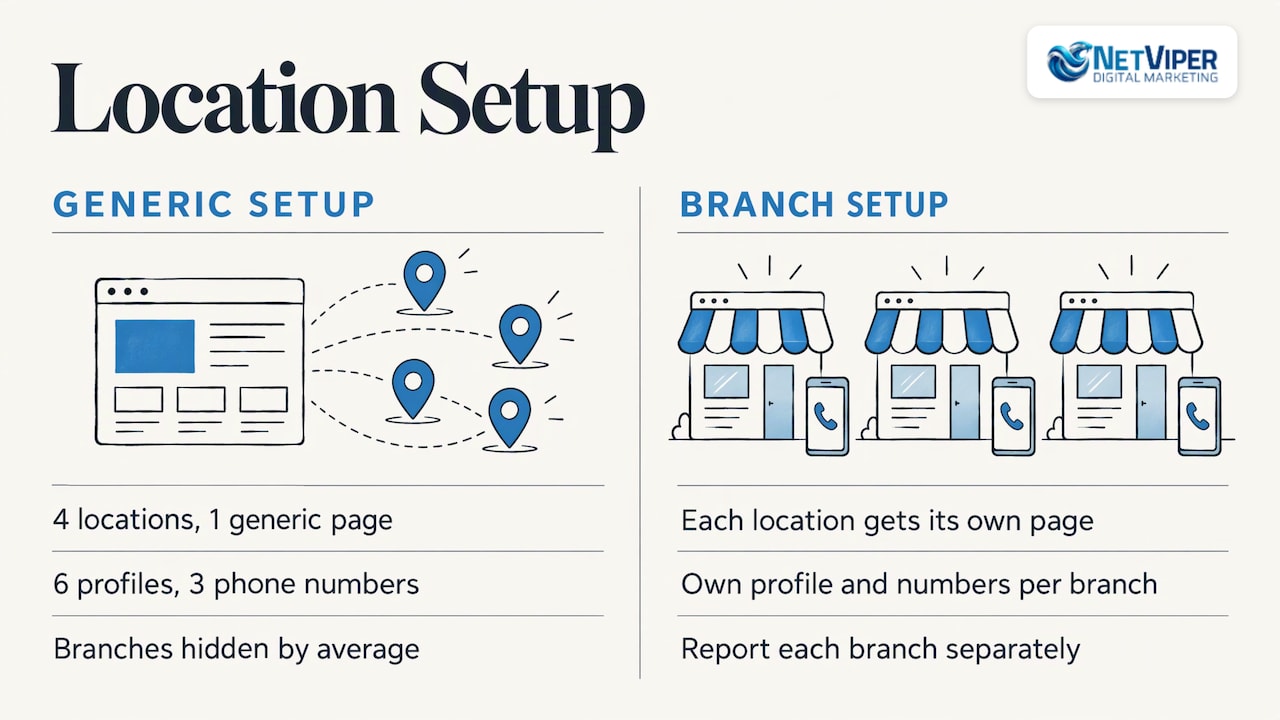
Most multi-location problems we see are structural, not clever. A business has four locations and one generic page, or six Google Business Profiles with three different phone numbers. The fix is rarely a trick. It is giving each location its own page, its own profile and its own numbers, then reporting on each one separately so no branch hides behind the average.
We believe local SEO works best when it is paired with a way to capture the lead. Visibility in Google Maps earns the call or the click. A fast response, whether from your staff or our AI receptionist tools, is what keeps that lead from going to the next business on the map. That is why we put SEO, landing pages and AI lead response in one program for Northeast Florida businesses.
Dave Fogel
Get a plan built around your locations
If you run more than one location or service area in Northeast Florida, our SEO plans start at $497 per month with GeoBoost 25 and scale to $1,697 per month with GeoBoost 100. You can review the options on our SEO services page, or see everything we offer, including the Full Digital Program, on our all services page.

For a Jacksonville-based business, our local marketing and local SEO for Jacksonville page shows how we work in your market.
FAQ
Does every location need its own page?
Every real location with its own address, hours and staff should have its own page. Service areas without a storefront only need a page when there is search demand and you have enough genuinely local content for it. Adding a city to a Business Profile service area does not require a page.
Can one Google Business Profile cover several locations?
No. Google’s guidelines allow one profile per staffed location. A service-area business with separate staffed locations and separate service areas may have one profile for each. Keep names and categories consistent across them.
How far can a service-area business extend its coverage?
Google lets you add up to 20 service areas by city, postal code or other area, and does not allow a radius. The overall boundary generally should not extend beyond about two hours’ driving time from where you are based.
How do I know multi-location SEO is working?
Track each location separately: rank by city or ZIP code, profile calls, direction requests and website clicks, reviews, and then the outcomes that matter, such as qualified calls and booked appointments. Compare against a baseline from when the work started, and look at individual locations rather than only the total.
What should a multi-location SEO proposal include?
Ask for a location-by-location scope: page work, profile optimization, listing cleanup, review workflow, reporting and the monthly fee. A proposal that itemizes these makes it clear what each location receives.
Sources
- Search Engine Land: Multi-Location SEO guide
- Search Engine Land: How to structure geographic pages for multi-location SEO
- Search Engine Land: How to segment SEO data for multi-location brands
- Semrush: Multi-location SEO strategy
- Search Engine Journal: Local SEO for multiple locations
- Backlinko: Multi-location SEO
- Google: Guidelines for representing your business
- Google: Manage your service areas
Recommended

Multi-Location SEO Services: What They Include and How to Choose
Multi-location SEO services explained for local business owners: pages, Google Business Profiles, listings, reviews and reporting for each location or service area.

SEO Pricing in Florida: What Local Businesses Pay in 2026
What SEO costs in Florida in 2026: monthly ranges, what each price level buys, and how to judge a quote, with NetViper’s published local SEO plans.

Local Business Advertising in Florida: Where to Spend First
How Florida local businesses can advertise: pick the right channels, win Google Maps and Search, track every lead, and respond to inquiries fast.
