
Online review management is the ongoing work of monitoring, requesting, answering and learning from the reviews customers leave about your business on Google, Facebook and other sites. For a local business, the core routine is simple: make it easy for happy customers to leave a review, reply to every review quickly and professionally, flag anything that breaks platform rules, and track the results month over month. This guide covers each step, the U.S. rules you need to follow, what to look for in a review management service, and how to tell whether it is working.
TL;DR
- Review management means monitoring, requesting, responding to and analyzing reviews. It is narrower than full online reputation management, which also covers social media, search results and comments.
- Google treats reviews as a prominence signal, so more reviews and better ratings help you appear in local search and Google Maps.
- Ask every customer, reply to every review, and move complicated complaints to private contact.
- In the U.S., you may not buy fake reviews or use threats to suppress honest ones, and incentives must never depend on a positive rating.
- Track review volume, average rating, response time and review-driven actions (calls, direction requests, website clicks) to see progress.
Table of Contents
- What online review management includes
- Why reviews matter for Google Maps and local search
- A review management workflow you can run every week
- How to respond to negative reviews
- What U.S. law allows: paying for reviews and review requests
- What to look for in an online review management service
- How to tell whether review management is working
- Our perspective
- How NetViper can help
- Frequently asked questions
- Sources
What online review management includes
The term is often mixed up with online reputation management. Forbes Advisor separates the two: reputation management is the broader job that spans reviews, social media, search results, ratings, posts and comments, while review management deals with reviews alone. For most local service businesses, reviews are the largest and most visible part of that reputation, which is why they deserve their own process.
QuestionPro describes review management as a systematic process of collecting, analyzing and responding to customer feedback on public platforms, built from five parts:
- Listening: knowing when a new review appears on any site.
- Analyzing: spotting patterns in what customers praise or complain about.
- Responding: replying publicly and consistently.
- Improving: fixing the operational problems reviews reveal.
- Encouraging: actively asking satisfied customers to share their experience.
A review management system is the software that supports those steps: a single inbox for reviews across sites, alerts, reply tools and reporting. An online review management service adds people on top of the software: someone who sets up the process, monitors it and often drafts or posts responses for you. Which you need depends on how many reviews you receive and how much time your team can spare.
Why reviews matter for Google Maps and local search
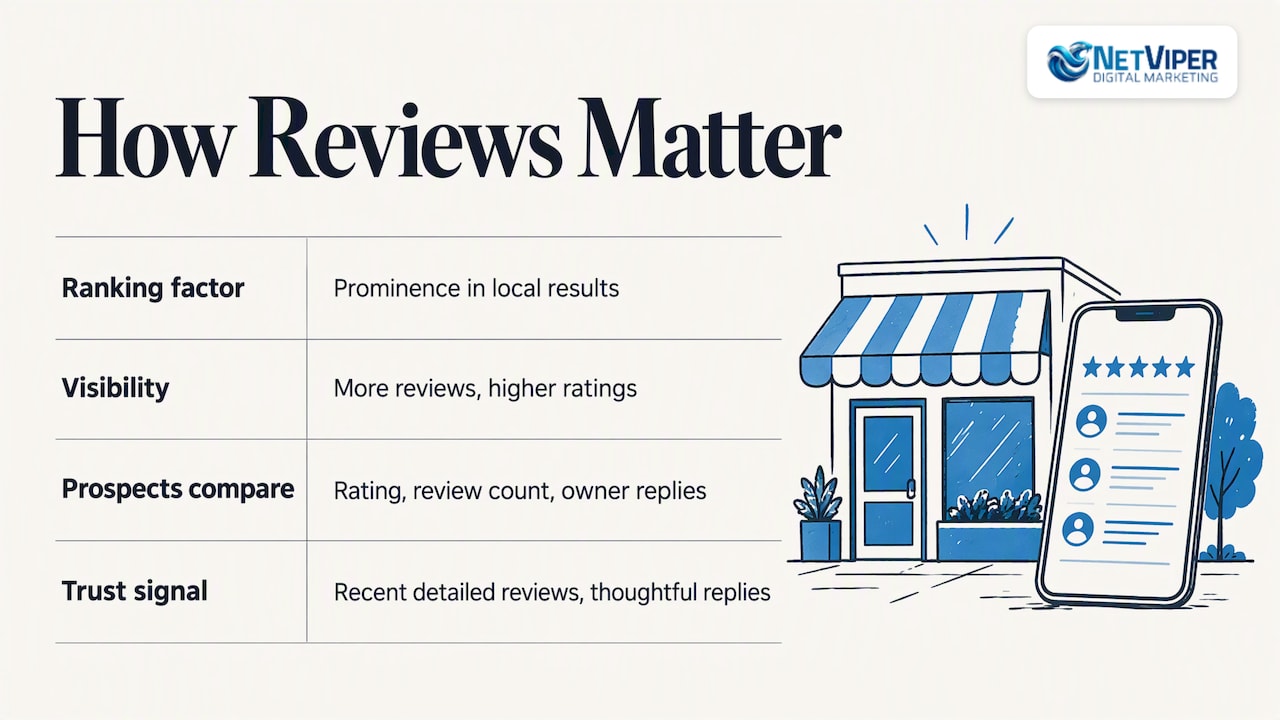
Reviews do two jobs at once. They persuade the person reading them, and they feed the ranking systems that decide who that person sees in the first place.
On the ranking side, Google describes reviews as part of the prominence factor in local results. As Search Engine Land’s guide to Google reviews explains, businesses with more reviews and higher ratings are more likely to show up in local search results and Google Maps. Reviews sit alongside relevance and distance, so they will not rescue a poorly set up profile, but they are one of the few ranking inputs your customers hand you directly.
On the persuasion side, a prospect comparing three plumbers, dentists or restaurants will usually look at star rating, number of reviews and whether the owner replies. A steady stream of recent, detailed reviews and thoughtful replies signals an active, trustworthy business. That is why review work belongs inside your local SEO plan, not beside it. If you are building that plan, our overview of local SEO for Jacksonville businesses shows where reviews fit with your profile, citations and website.
A review management workflow you can run every week
A good process is boring and repeatable. Here is the version we recommend for a local business.
Step 1: Claim and complete your profiles
Start with your Google Business Profile, then the other sites your customers use (Facebook and any industry directories). Accurate name, address, phone number, hours and categories come first, because reviews attach to those listings. Consistent listings across the web also reduce confusion about which business is which; see our guide to local listings management for how to keep them aligned.
Step 2: Assign an owner
The Better Business Bureau recommends assigning responsibility for monitoring and responding so your messaging stays consistent. Name one person, and one backup. Without that, replies come late, in different tones, or not at all.
Step 3: Ask for reviews at the right moment
Google’s own guidance is to ask customers to leave a review, using a direct Google link or a QR code so the process takes seconds. Practical moments to ask:
- Right after a job is completed or an appointment ends, while the experience is fresh.
- In the follow-up text or email that confirms payment or thanks the customer.
- On a printed card, receipt or counter sign with the QR code.
Ask everyone, not only the customers you suspect are delighted. That keeps your ratings honest and, as the next section explains, keeps you inside the rules.
Step 4: Respond to every review
Google advises replying professionally, briefly, conversationally and promptly, personalizing each response and protecting customer privacy. A few habits make this easy:
- Use the reviewer’s name and mention one specific detail from their visit.
- Keep positive replies to two or three sentences.
- Never include private details such as account information, medical or financial specifics.
- Skip copy-and-paste answers. Readers notice them.
Step 5: Review the patterns monthly
Once a month, read the batch together. If three reviews mention long wait times or unclear pricing, that is an operations problem, and fixing it improves the reviews you get next quarter. This is the “improving” step in the five-part process above, and it is where review management pays back beyond marketing.
How to respond to negative reviews
A negative review is a public moment where future customers watch how you behave. The approach Google recommends is consistent: respond professionally and promptly, and take complicated issues out of the public thread into private contact.
A reply structure that works:
- Thank and acknowledge. “Thank you for telling us about this. We’re sorry the visit fell short.”
- Address the specific issue without arguing or blaming the customer.
- Offer a direct line. Give a phone number or email and invite them to continue the conversation offline.
- Stay short. Long defensive replies make a small complaint look bigger.
If you believe a review violates Google’s policies, for example it is spam, off-topic or clearly fake, you can flag it for Google to evaluate. Flagging is for rule violations. A harsh but genuine opinion is not a violation, and the best response to it is still a calm reply and a fix.
On AI-assisted replies, the BBB notes that AI can sort sentiment, flag recurring or urgent issues and draft responses, but it should not replace human empathy. Use drafting tools to save time, and have a person read every reply before it goes live, especially on negative reviews.
What U.S. law allows: paying for reviews and review requests
Readers often ask whether it is legal to pay for online reviews. The short answer from the FTC’s guidance is that you must never buy fake reviews, and that incentives for genuine reviews carry strict conditions.
The FTC finalized a rule on fake reviews and testimonials in August 2024. It prohibits creating or selling reviews that misrepresent who wrote them or whether they had real experience with the business, including AI-generated fakes, and it lets the agency seek civil penalties from knowing violators.
The agency’s questions and answers on the rule add the practical details for everyday businesses:
- Incentives: offering something in exchange for a review is allowed only if it is not conditioned on the sentiment expressed. A discount for “a five-star review” is out. A thank-you for an honest review of any rating is the safer pattern. Failing to disclose an incentive could violate the FTC Act.
- Suppression: you may not use threats, intimidation, physical threats or unfounded legal threats to prevent or remove reviews, and you may not make knowingly or recklessly false accusations against reviewers.
- Fake reviews: do not buy them, and do not ask staff or relatives to post as customers.
The safest policy is the plainest: invite every customer to share an honest opinion, reply to what they write, and never trade value for a particular rating. If you are considering any incentive program, have your attorney review it first, since the details of disclosure matter.
What to look for in an online review management service
Whether you choose software, an agency, or a mix, judge the options against how your business actually works. These are the features and service qualities that matter most for a local business.
| What to look for | Why it matters |
|---|---|
| Monitoring across Google, Facebook and industry sites | You cannot reply to what you do not see. Alerts should reach the right person quickly. |
| Simple request tools (links, QR codes, text or email) | Asking is the biggest driver of volume, so it has to take seconds for staff. |
| Reply workflow with approvals | Keeps tone consistent and lets a manager sign off on negative responses. |
| Compliance with platform and FTC rules | No gating by sentiment, no fake reviews, no incentives tied to ratings. |
| Reporting you can read | Volume, rating trend, response time and topics, not just a star average. |
| Connection to your local SEO | Reviews should support your Google Business Profile and Maps visibility. |
| A named person to talk to | Someone who knows your market and answers when a review turns difficult. |
Be wary of any provider that promises a specific star rating, a fixed number of five-star reviews or removal of honest negative reviews. Those promises either cannot be kept or point toward practices the FTC rule targets.
How to tell whether review management is working
Set a baseline before you begin, then compare monthly. These measures cover the full picture:
- Review volume per month: the number of new reviews on Google. Aim for steady growth, not a spike.
- Average rating and its trend: watch the direction over several months, not a single week.
- Recency: are your newest reviews recent? A profile with plenty of reviews that are all a year old looks inactive.
- Response rate and response time: the share of reviews you answered, and how long it took.
- Request conversion: how many customers you asked versus how many left a review. This tells you whether your ask is working.
- Profile actions: calls, direction requests and website clicks from your Google Business Profile insights.
- Map visibility: where you appear for your main service searches in the neighborhoods you serve.
Keep the numbers in one simple spreadsheet. If volume rises and profile actions do not, look at your profile content and website. If actions rise but conversions to booked jobs do not, the problem is usually follow-up speed, which is where tools such as AI chatbots and receptionists can help capture leads the moment they arrive.
Our perspective
We see the same pattern with local businesses across Northeast Florida: the owners who treat reviews as a weekly habit outperform those who treat them as a clean-up job after a bad one.
Reviews are not a separate marketing channel. They are the proof layer under everything else you pay for. A well-run Google Ads campaign sends a prospect to your listing and your site, and the stars and replies they see there decide whether they call. A strong Maps presence depends on reviews as a prominence signal. When we build local SEO programs, we treat review requests, replies and listing accuracy as one connected system, with a real person in your market accountable for it.
Our approach is to make asking effortless for your staff, reply fast and in your own voice, and tie the review data back to leads and booked work. We also believe in speed on the other end: a customer who reads your reviews and then contacts you should get an answer immediately, which is why we pair local SEO with AI lead-response tools designed to make sure no inquiry sits unanswered.
And we keep it clean. No purchased reviews, no rating-based incentives, no shortcuts that put your business at risk with Google or the FTC.
Dave Fogel
How NetViper can help
If you would rather have a local team handle the routine, our local SEO programs cover the pieces that make reviews work: Google Business Profile optimization, listings and citations, and ongoing local ranking work for Jacksonville, St. Augustine and the surrounding area. Our current published pricing includes GeoBoost 25 at $497 per month and Listings & Citations at $60 per month, and for businesses that also want ads, AI lead response and a conversion-focused website, the Full Digital Program is $1,995 per month with a one-time set-up fee of $2,500.
See the details on our local SEO plans or browse all NetViper services to find the right fit, then reach out for a conversation about your market. If you want to compare providers first, our guide on how to choose an SEO company in Jacksonville lists the questions to ask.
Frequently asked questions
What is the online review process?
It is the cycle of finding where customers review you, asking happy customers to leave feedback, replying to each review, and analyzing patterns to improve. The steps repeat continuously, so the practical goal is a weekly routine with one person responsible. The five parts are listening, analyzing, responding, improving and encouraging.
Is it legal to pay for online reviews?
You may not buy fake reviews, and the FTC’s rule lets it seek civil penalties from knowing violators. Incentives for genuine reviews are allowed only when they are not conditioned on the sentiment expressed, and undisclosed incentives could violate the FTC Act. Check any program with your attorney.
What is a review management system?
It is software that gathers your reviews from multiple sites in one place, alerts you to new ones, helps you request reviews and reply, and reports on trends. A service pairs that software with people who run the process for you. Most small businesses need the process first and the tool second.
Should I respond to every review, including negative ones?
Yes. Google advises replying professionally, briefly and promptly, personalizing each response and keeping private details out of public replies. For negative reviews, acknowledge the problem, offer a direct contact and take the details offline. Flag reviews only when they appear to violate Google’s policies.
How many reviews do I need to rank in Google Maps?
There is no official number. Google says review count and rating contribute to prominence, alongside relevance and distance. Compare your totals and recency with the businesses ranking above you in your service area, then set a monthly target to close the gap.
Sources
- Online Reputation Management: The Ultimate Guide, Forbes Advisor
- Review Management: What It Is, How to Do It, and Tools, QuestionPro
- Google Reviews & SEO: Advanced Strategies That Scale, Search Engine Land
- Tips to get more reviews, Google Business Profile Help
- BBB Business Tip: Why responding to your customer reviews matters
- The Consumer Reviews and Testimonials Rule: Questions and Answers, FTC
- FTC Announces Final Rule Banning Fake Reviews and Testimonials
Recommended

Local Business Advertising in Florida: Where to Spend First
How Florida local businesses can advertise: pick the right channels, win Google Maps and Search, track every lead, and respond to inquiries fast.

Local Search Ranking Factors: What Moves You Up in 2026
Google ranks local businesses on relevance, distance and prominence. Here are the local search ranking factors you can control, in order of priority.

Chatbot Development for Business: What It Involves and How to Start
Chatbot development for business explained: what a chatbot can do, how projects are built, what to plan for, and how local businesses get one live without the guesswork.
