
A Google Ads agency builds, runs and improves your paid search campaigns so your ad budget produces calls, form fills and booked jobs instead of empty clicks. The right one sets up conversion tracking first, manages bids and keywords continuously, reports on leads rather than traffic, and charges a fee that is clearly separate from what you pay Google. This guide explains what that work involves, how pricing is structured, how much budget you need, and how a local business should evaluate an agency before signing.
TL;DR
- An agency handles setup, keyword research, ad copy, bidding, landing pages, conversion tracking and reporting. You pay Google for clicks and the agency for management, and the two are separate.
- Published U.S. pricing guides describe management fees as a flat monthly retainer or roughly 10 to 20% of ad spend. Confirm what is included before you compare quotes.
- Google’s own guidance says conversion tracking should be in place before you use conversion-based Smart Bidding. If an agency cannot show you tracking, keep looking.
- Local businesses should ask how an agency handles calls, Local Services Ads and the Google Business Profile, not just search keywords.
- Judge an agency on cost per lead and booked revenue, not clicks or impressions.
Table of Contents
- What a Google Ads agency actually does
- How Google Ads management works, step by step
- How much a Google Ads agency costs
- Is $10 a day enough for Google Ads?
- What local businesses should expect from Google Ads
- What AI-driven bidding means for management
- How to evaluate a Google Ads agency
- Our perspective
- Work with a local Google Ads team
- FAQ
- Sources
What a Google Ads agency actually does
Strip away the sales language and the job has five parts: plan, build, launch, measure and improve. Google’s own account-management documentation lists the areas a person managing an account may handle: ads and assets, campaigns and experiments, keywords, audiences, locations, content exclusions, ad schedules, conversion measurement, attribution, URL options and bid adjustments. That list is a useful checklist. A real management engagement touches all of it, not only the ads you see on the results page.
In practice, the work breaks down like this:
- Goal and offer review. What counts as a win: a phone call, a form, a booked estimate? What is a lead worth to you?
- Keyword and audience research. Finding the searches that signal buying intent in your service area, and excluding the ones that waste money.
- Account structure and ad copy. Grouping keywords tightly and writing ads that match what the searcher typed.
- Landing pages. Sending clicks to a page built for one action, not your home page.
- Tracking, bidding and weekly optimization. Cutting what does not convert, shifting budget to what does, and testing new ads.
That last step is where most of the value sits. A campaign is never finished. Search terms change, competitors raise bids, and seasonality moves demand.
How Google Ads management works, step by step
Google’s official setup guide describes a flow from business information and campaign goal to ad assets, audience, budget, payment and launch, and advises verifying conversion tracking, measuring results, using Smart Bidding and refining targeting. Google Ads Help adds that setup includes defining conversion actions, installing the Google tag, researching keywords with Keyword Planner and choosing bidding that matches the business goal. Its examples of conversions include purchases, sign-ups and calls.
The sequence a good agency follows:
- Before launch: define conversion actions (calls, forms, bookings), install the tag, and confirm each action fires correctly.
- At launch: start with tightly themed Search campaigns, a realistic budget and bidding that fits your data volume.
- First 30 to 60 days: review search terms, add negative keywords, test ad variations and watch cost per conversion.
- Ongoing: move budget toward the campaigns, locations and hours that produce leads, and keep landing pages improving.
Why conversion tracking comes first
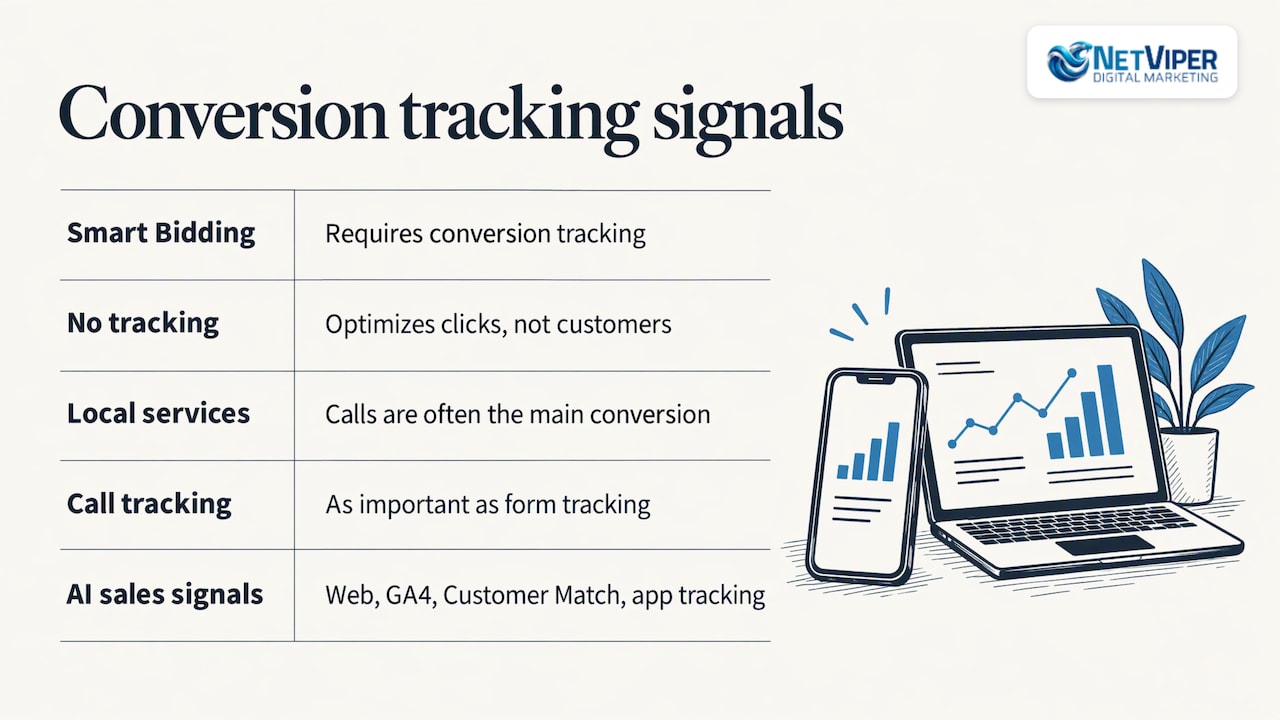
Google’s guidance says Smart Bidding strategies such as Maximize conversions require conversion tracking. Without it, the automation has nothing to learn from and optimizes toward clicks instead of customers. For local service businesses, phone calls are often the main conversion, so call tracking matters as much as form tracking. We cover that in detail in our guide to call tracking for ads.
Google also notes that website conversion tracking, GA4, Customer Match and app conversion tracking can feed measurement signals into its AI-powered sales campaigns. The better the signal, the better the automation performs.
How much a Google Ads agency costs
There are two separate costs, and mixing them up is the most common budgeting error.
- Ad spend: what you pay Google when people click or call.
- Management fee: what you pay the agency to run the account.
Published U.S. pricing guides, such as RankTracker’s 2025 guide, describe flat monthly retainers across a wide range, most often in the low thousands of dollars or less, and percentage fees of 10 to 20% of monthly ad spend. Treat any such range as a rough orientation. Your actual quote depends on account size, number of campaigns, and whether setup, landing pages and creative are included or billed on top.
Flat fee or percentage of spend
| Fee model | How it works | Best fit | Watch for |
|---|---|---|---|
| Flat monthly retainer | Same fee regardless of spend | Businesses that want predictable costs | Scope: what is and is not included |
| Percentage of ad spend | Typically 10 to 20% of what you spend | Larger or fast-scaling accounts | Fee rises when spend rises, even if results do not |
| Hourly or coaching | Paid by the hour for advice or audits | Teams that run ads in-house | You still do the weekly work |
A flat retainer keeps the agency’s incentives simple. A percentage model can work well at higher spend but ask what happens to the fee if you raise budget.
What our pricing looks like
Our Google Ads management is scoped to the account, so we do not publish a single price for it. What we do publish: our Full Digital Program is $1,995 per month with a one-time set-up fee of $2,500. Paid Ads Coaching is $225 per hour, and a Conversion Tracking Audit is $175 per hour, for owners who want to keep ads in-house but need an expert to check the work. Ad spend is always paid to Google directly and is separate from our fees.
Is $10 a day enough for Google Ads?
It can run, but it rarely answers the question that matters. Google explains that an average daily budget is set per campaign, that spending on a given day can reach up to twice that average, and that the monthly limit is 30.4 times the daily figure. So $10 a day means roughly $304 in a month at most.
Whether that is enough depends on three things:
- Cost per click in your market. Plumbing, legal and home-service keywords can be far more expensive than a niche retail term. If a click costs $10 or more, a $10 daily budget buys about one click.
- Your conversion rate. If one in ten visitors calls, you need ten clicks per lead.
- What a customer is worth. If a new customer is worth $2,000, you can afford more per lead than if a sale is worth $60.
A simple way to plan: decide how many leads you want per month, multiply by the cost per lead you can afford, and set the budget from there. Starting too small gives Google too little data to learn from, which slows improvement.
What local businesses should expect from Google Ads
Local businesses have options beyond standard search campaigns. Google’s small-business guidance distinguishes Search campaigns, Local Services Ads and Performance Max. It says advertisers pay per click or call, can cap their monthly budget and can stop advertising at any time. It also says Local Services Ads can generate leads and bookings for eligible businesses such as plumbers and dentists. If you are in an eligible trade, read our walkthrough on managing Local Services Ads.
Ads and Google Maps are different channels
Google says free Business Profiles help local businesses appear on Search and Maps, while paid campaigns are a separate option. That distinction matters. Ads buy immediate visibility. Map rankings come from your profile, reviews, citations and local relevance. The strongest local presence uses both: ads to capture demand today, and a well-maintained profile and consistent local listings to earn free visibility over time. In the Northeast Florida market, that is how we pair our local SEO work with paid search.
What AI-driven bidding means for management
Google Ads runs an auction whenever an ad space becomes available, and advertisers can optimize bids for clicks, impressions, conversions, views or engagements, according to Google’s bidding basics. With cost-per-click bidding you are charged when someone clicks. Automated bidding makes many of those decisions in real time.
This does not remove the need for management. It moves it. The manager’s job becomes feeding the system accurate conversion data, setting sensible targets, controlling which searches and locations are eligible, and judging whether the results make business sense.
Google identifies key Search-campaign measures: conversion rate, conversion value, ROAS, conversions, cost per conversion and average CPC, with clicks and CTR showing how appealing your ads are. A useful monthly report leads with conversions and cost per conversion, and treats clicks as supporting detail.
How to evaluate a Google Ads agency
Use these criteria when you compare proposals.
- Tracking before spending. Ask how calls, forms and bookings will be measured, and ask to see the conversion actions in your account.
- Account ownership. The Google Ads account should be in your name, with the agency as a manager. You should be able to see everything.
- Clear scope and fees. Know whether setup, landing pages, creative and call tracking are included, and how the fee changes if spend changes.
- Reporting on outcomes. Insist on cost per lead and lead quality, not just impressions.
- Local knowledge. Someone who knows your service area, seasons and competitors will set better geographic targeting and ad copy.
- Contract terms. Ask about minimum terms and how to exit.
- Landing pages and follow-up. Clicks are only valuable if the page converts and someone responds fast. Our work on landing page optimization and automated lead follow-up exists because the ad is only half of the result.
Questions to ask in the first call
- What will you track as a conversion, and how will you verify it fires?
- Who will actually work in my account each week?
- What does the fee cover, and what costs extra?
- How will you report, and how often?
- What do you do when a campaign is getting clicks but no leads?
Vague answers to any of these are a signal to keep looking.
Our perspective
We see the same pattern with local owners in Northeast Florida: the ads are rarely the whole problem. A business pays for clicks, then loses the lead because the call goes to voicemail, the landing page is generic, or nobody tracked which keyword produced the job.
That is why we treat Google Ads management as a system. Certified specialists build and tune the campaigns, we set up conversion tracking so spend is judged on leads, and we pair ads with local SEO, custom landing pages and AI tools such as chatbots and voice agents so inquiries get an instant response. When a lead arrives at 9 p.m., it should still get answered.
Local expertise matters too. Knowing Jacksonville, St. Augustine and Ponte Vedra customers, and the way they search, lets us target the right neighborhoods and cut the waste. Owners get direct access to the people doing the work, and the numbers that matter: calls, leads and cost per lead.
Dave Fogel
Work with a local Google Ads team
If you run a business in Northeast Florida and want campaigns managed by specialists who track every call and form, start with our Google Ads management and PPC experts page. We also serve Jacksonville and St. Augustine directly. The Full Digital Program bundles management with the supporting pieces for $1,995 per month plus a $2,500 one-time set-up fee.
For a deeper look at scope and fees, see what paid search management includes and costs.
FAQ
How much does a Google Ads agency cost?
Published U.S. guides describe flat retainers or fees of roughly 10 to 20% of ad spend, plus the ad spend itself paid to Google. Setup, landing pages and creative may be billed separately. Ask for a written scope so you can compare quotes fairly. Our published plans are listed on our pricing page.
Is $10 a day enough for Google Ads?
It is enough to run a campaign, but often not enough to learn from it. Google’s budget rules allow daily spend to reach twice the average, with a monthly limit of 30.4 times the daily budget. Whether it is enough depends on your cost per click and conversion rate.
What does pay-per-click management include?
It typically covers keyword research, campaign setup, ad copy, bid management, conversion tracking, search-term review and regular reporting. Google’s account documentation lists the same areas: ads, keywords, audiences, locations, schedules, bids and conversion measurement.
Should I hire an agency or manage Google Ads myself?
If you have time to review search terms weekly and understand conversion tracking, in-house can work, and coaching or an audit can speed you up. If ads are one of many jobs on your plate, a specialist usually protects your budget better. Either way, keep the account in your own name.
Sources
- How To Set Up Your First Google Ads Campaign, Google Ads
- Set up your campaign for success, Google Ads Help
- Navigate your Google Ads serving account, Google Ads Help
- Maximize your online sales with Google Ads, Google Ads Help
- Google Ads Management Services Pricing in the United States, RankTracker
- About average daily budgets, Google Ads Help
- Getting started with Google Ads: Tips for small businesses, Google
- Understanding bidding basics, Google Ads Help
- Use data to optimize your Search campaigns, Google Ads Help
Recommended

Jacksonville Small Business Website Design: What Your Site Needs
What a Jacksonville small business website needs to win local searches, Google Maps visibility and ad leads, and how to judge whether your site is working.

Landing Page Conversion Rate: What’s Good and How to Raise It
Learn how to calculate your landing page conversion rate, what benchmarks to expect, and which changes lift lead conversions for a local business.

Voice AI for Business: Where It Pays Off and How to Start
Voice AI answers calls, books appointments and follows up with leads around the clock. Learn where it works, what to check first, and how a local business starts.
